Back to home@phuongddx

jarvis

JARVIS is an intelligent layer that gives agents access to their code, knowledge, context, memory, tools, and runtime — starting locally on your machine, with the ability to extend into the cloud.

Stars
0
Language
Python
Created
Jul 25, 2026
Updated
Sep 10, 2026

Introduction

jarvis

CI PyPI Python Platforms License: MIT MCP

Local-first code intelligence for coding agents. Precomputed SCIP navigation (go-to-definition, find-references, call/type hierarchy, document symbols), Zoekt lexical search, natural-language semantic search, and cross-repo blast radius — exposed as nine MCP tools for Claude Code, Cursor, or any MCP client.

One indexing CLI writes up, one stdio runtime reads down — the storage seam in ~/.jarvis is the only contract between them. No server, no auth, no network, nothing leaves your machine.

What is it? · How it works · Quick start · MCP tools · Requirements and limits · Indexing · Configuration · Documentation

What is it?

Without jarvis, asking your agent "where is AuthService used?" means grepping for the string, re-reading whole files to filter false positives, and guessing at call sites — burning context window on search instead of reasoning.

With jarvis, the agent calls findReferences and gets exact file-and-range occurrences from a precomputed SCIP index, callHierarchy for the call graph, and semanticSearch for questions like "where is token refresh handled?" in plain language.

Think of it as grep, but matching symbols, definitions, and references — indexed once per repo, answered in milliseconds.

  • Declaration-level navigation without any indexer — a Tree-sitter syntax baseline (17 languages) is built on every jarvis index run from pip-installed grammars, no compiler or build system required — on top of a precomputed SCIP index for full precise navigation (TypeScript/TSX, Python, Java/Kotlin, Swift), Zoekt lexical search, and optional vector search, all from local SQLite/LanceDB files.
  • Read-only by design. jarvis never edits code; it is the retrieval half. If you want an agent that performs semantic renames and refactors, you want Serena — the two are complementary.

jarvis is deliberately narrow: one language per repo, macOS/Linux only, and indexing is an explicit step — see Requirements and limits before installing.

How it works

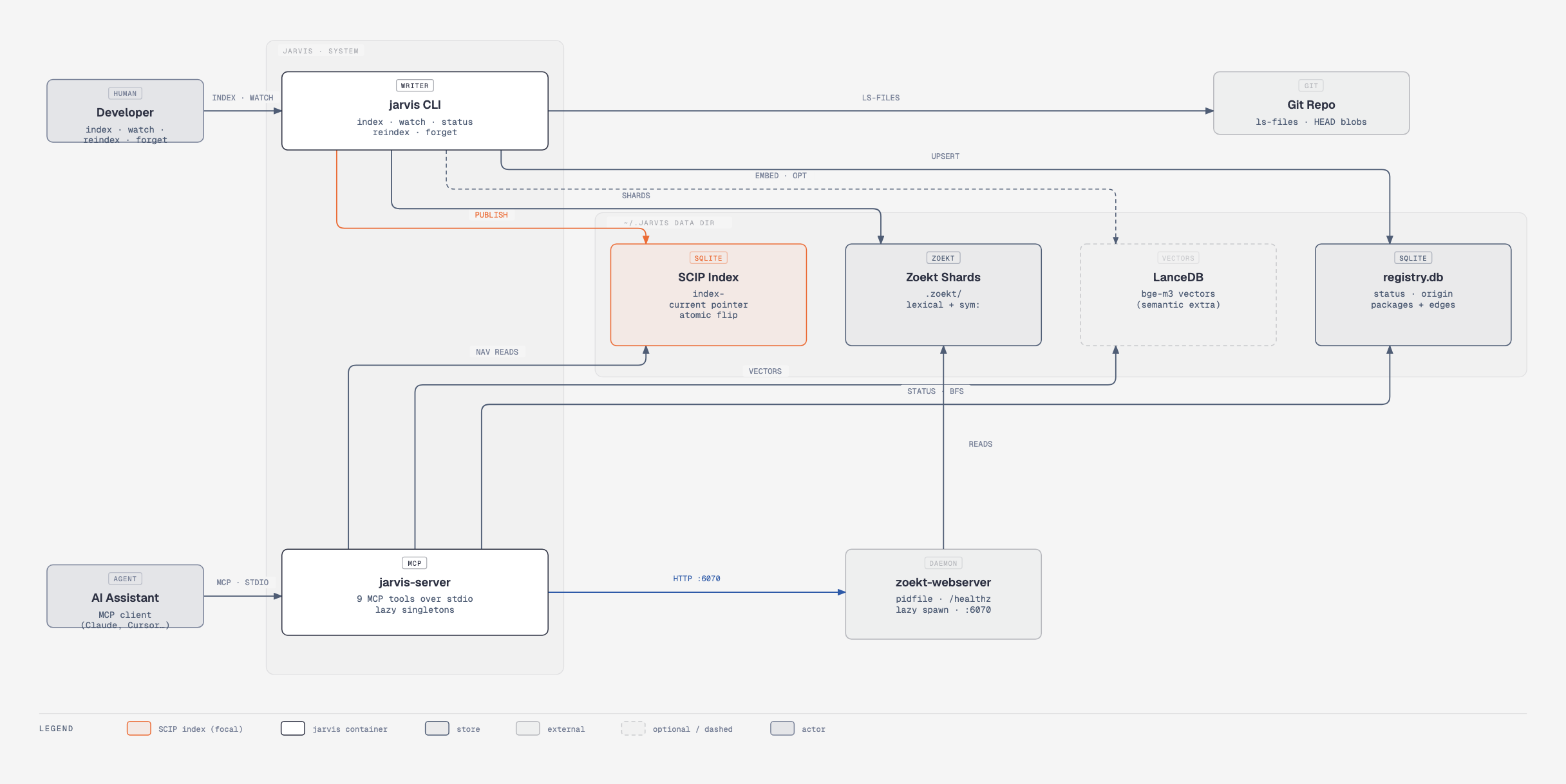
jarvis architecture: a writer CLI and an MCP reader inside the jarvis system boundary, both talking to four stores in the local data dir — the immutable SCIP index, Zoekt shards, LanceDB vectors, and the registry — plus the git repo and a lazily spawned zoekt-webserver 1. **Index.** `jarvis index /repo` builds a Tree-sitter syntax baseline for every supported file first, then optionally runs the language's SCIP indexer and converts the result to SQLite, builds Zoekt shards (plus optional embeddings), and publishes everything **atomically** into `~/.jarvis` as one immutable snapshot selected by a single `current` pointer. SCIP tooling missing or failing degrades the run to exit-0 — the baseline still publishes. 2. **Serve.** `jarvis-server` speaks MCP over stdio and exposes nine tools, backed by lazy singletons; a `zoekt-webserver` is spawned on first search and shared across processes via pidfile. 3. **Ask.** Your agent calls tools. Every query opens the published `index--.db` read-only (`mode=ro&immutable=1`) — the runtime path never writes.

Storage is the seam. The runtime half only ever reads down into it; the indexing half only ever writes up into it; the two share no other contract. Three load-bearing consequences:

  • The runtime path never writes. Index files are never mutated in place.
  • Publishing is atomic. A reindex writes a new versioned .db, populates the package graph, and runs zoekt-index — only once all of that succeeds does os.replace (POSIX rename(2)) flip the small current pointer. A query already reading the old file keeps working; there is no downtime window, and a failure anywhere leaves the previously published index live.
  • The package graph is rebuilt, not accumulated. Each reindex clears that repo's own outgoing edges before recomputing them, so blastRadius always reflects each repo's last index run.

Layer-by-layer detail, the full index pipeline, and the semantic path are in docs/system-architecture.md. Core query/search logic is ported from an internal reference implementation; the enterprise shell (FastAPI, Postgres, hosted-git auth, Cloud Build) is dropped in favor of a single stdio process reading local SQLite files.

Quick start

1. Install the external indexer binaries (only needed for optional SCIP navigation and Zoekt search — the Tree-sitter syntax baseline ships inside the pip package and needs no external binary): scip, zoekt, per-language indexers:

curl -fsSL https://raw.githubusercontent.com/jarvis-intelligence/jarvis-index/main/setup.sh | sh

2. Install jarvis:

uv tool install jarvis-mcp

3. Index a repo (slug defaults to the directory name):

jarvis index /path/to/your/repo

4. Register the MCP server. Using Claude Code, install the plugin and it registers itself:

/plugin marketplace add jarvis-intelligence/jarvis-index
/plugin install jarvis@jarvis

Any other MCP client (or Claude Code without the plugin) registers manually:

claude mcp add jarvis --scope user -- jarvis-server

That's it — ask your agent "find all references to AuthService" and it will call findReferences instead of grepping.

Other MCP clients (Cursor, Claude Desktop, any stdio client)
{
  "mcpServers": {
    "jarvis": {
      "command": "jarvis-server"
    }
  }
}

If your client can't find jarvis-server on PATH (GUI apps often don't inherit your shell's), use the absolute path from which jarvis-server.

Running from a clone instead
git clone https://github.com/phuongddx/jarvis && cd jarvis
uv sync
claude mcp add jarvis --scope user -- uv --directory "$(pwd)" run jarvis-server
Optional extras
uv tool install "jarvis-mcp[watch]"      # + watchdog, for `jarvis watch`
uv tool install "jarvis-mcp[semantic]"   # + lancedb/sentence-transformers, for semanticSearch

MCP tools

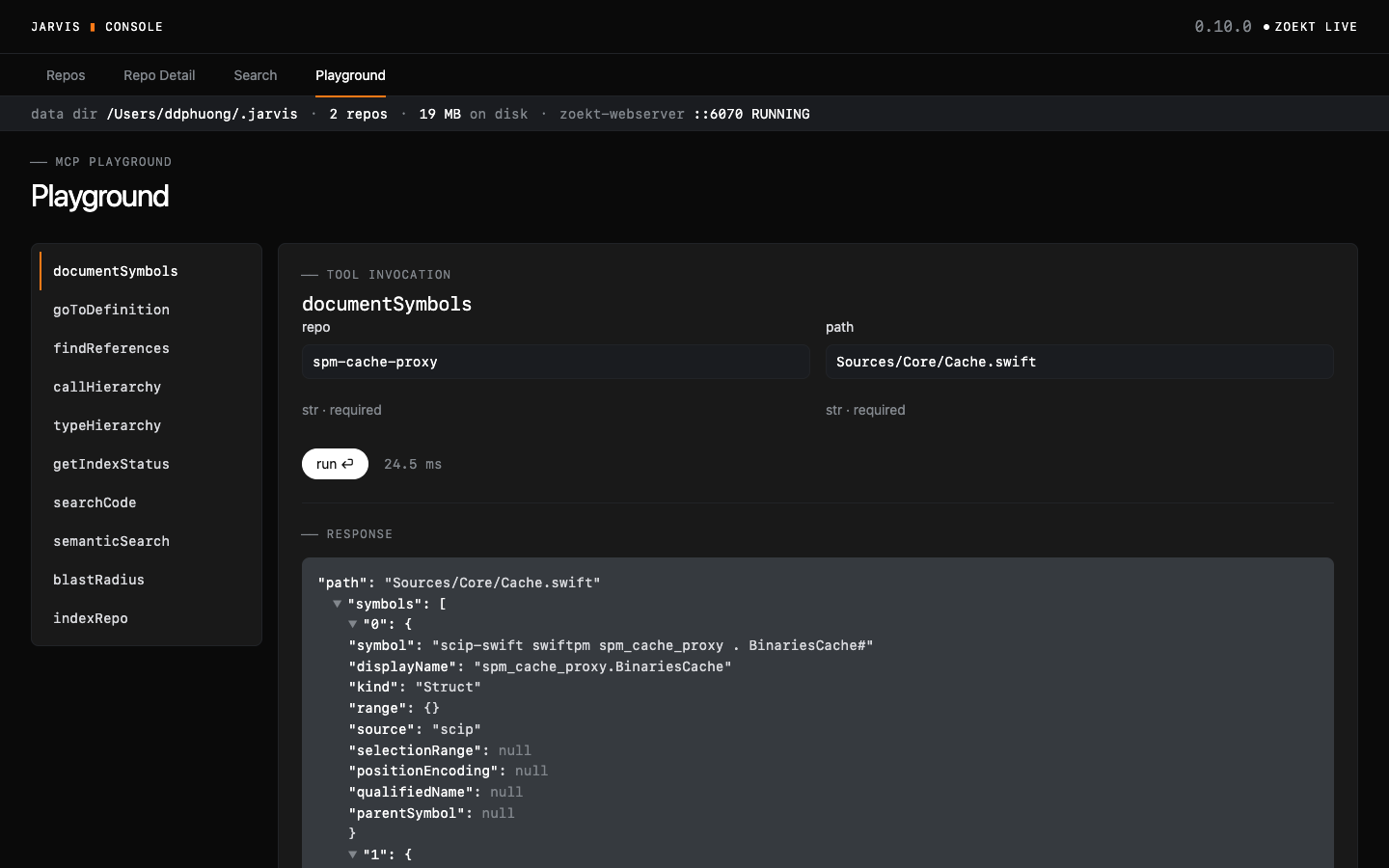
| goToDefinition | Resolve a symbol to its defining file and range — SCIP when the file has SCIP definition coverage, otherwise the syntax baseline's declaration; each location carries source ("scip" or "tree-sitter") and positionEncoding | | findReferences | Every occurrence of a symbol across the indexed repo — SCIP-only: without usable SCIP occurrence data it returns requiredCapability/reason/recovery, never an empty list | | callHierarchy | Incoming/outgoing calls for a symbol — SCIP-only (same contract as findReferences) | | typeHierarchy | Supertypes/subtypes — SCIP-only; needs an index built with the bundled scip, see limitations | | documentSymbols | Outline of every symbol defined in one file — routed per file: the SCIP outline when usable, otherwise Tree-sitter declarations; a syntax-served response carries a coverage object (parsed/partial/failed counts and reason) | | searchCode | Zoekt lexical/regex search, optionally filtered to one repo | | semanticSearch | Natural-language search — vector hits fused with Zoekt lexical hits and SCIP symbol-definition matches via reciprocal rank fusion | | blastRadius | Which other indexed repos depend on a package, up to 2 hops | | getIndexStatus | Published commit, freshness, staleness vs. a working tree; capabilities.tools reports per-tool providers, capabilities.syntax reports extraction counts, and freshness names the snapshot generation |

documentSymbols/goToDefinition are per-file provider routed: a file with usable SCIP coverage is answered by SCIP (full identifiers, references, hierarchies); a file without it is answered by the syntax baseline's real Tree-sitter declarations, whose opaque syntax: identifiers round-trip through goToDefinition. Bare or qualified names search both providers, so an ambiguous name returns combined candidates from both.

Every nav tool takes repo (the slug from jarvis index) plus a tool-specific symbol or path. All tools report failure the same way — a {"error": "..."} payload rather than a transport-level error, so a query bug never kills the stdio server.

Requirements and limits

Read this before installing — jarvis is deliberately narrow.

  • macOS and Linux only. Windows is not supported.

  • One language per repo. Language is detected by extension plurality across git-tracked files; a polyglot monorepo gets indexed as whichever language has the most files. Multi-language merge is out of scope. Override with --language.

  • Build-free syntax baseline covers 17 languages — Python, JavaScript, TypeScript/TSX, Java, Kotlin, Swift, Go, Ruby, Rust, C, C++, C#, PHP, Scala, Bash, and SQL — served by documentSymbols/goToDefinition as declaration outlines. Grammars are pip-installed dependencies of the package itself (no external binary, no download at index time); a repo with none of these still gets Zoekt search.

  • Precise SCIP navigation (findReferences, callHierarchy, typeHierarchy) covers four language families: TypeScript/TSX, Python, Java/Kotlin, Swift. These tools require real SCIP data — without it they explain what is missing and how to retry rather than returning empty results.

  • Navigation and search only — jarvis never edits code. If you want an agent that can perform semantic renames and refactors, you want Serena; the two are complementary.

  • Indexing is a separate, explicit step. Nothing is live-analyzed. Run jarvis index (or jarvis watch) to publish an index before querying.

  • Optional SCIP/Zoekt enrichment requires external binaries that setup.sh installs (the syntax baseline itself ships in the wheel):

    PurposeBinarySource
    SCIP → SQLite conversionscipprebuilt, pinned v0.9.0 (minimum — older versions silently drop occurrence ranges)
    Lexical searchzoekt-git-index · zoekt-webservercross-compiled by our CI — upstream publishes no binaries
    Zoekt symbol queries (sym:)universal-ctagssystem package manager via setup.sh — without it sym: silently returns nothing
    TypeScript indexingscip-typescriptnpm install -g
    Python indexingscip-pythonnpm install -g
    Swift indexingscip-swiftprebuilt, macOS arm64 only
    Java/Kotlin indexingscip-javadetect-only — Docker image, asks before pulling

    Options: --only <name> to install one dependency, --force to reinstall, --help for usage. Re-running is safe: anything already present is skipped.

Indexing a repo

jarvis index /path/to/your/repo            # slug defaults to the directory name
jarvis index /path/to/your/repo --slug foo # or pick one explicitly
jarvis index /path/to/your/repo --scheme MyScheme # Swift repo with an ambiguous Xcode scheme
jarvis index /path/to/your/repo --language python # force the language instead of detecting it from git-tracked files
jarvis index /path/to/your/repo --semantic-include vendor/generated # force-include a path the generated-file filter would otherwise skip
jarvis index /path/to/your/repo --no-scip   # skip optional SCIP enrichment; the syntax baseline + Zoekt still publish (exit 0)
jarvis index /path/to/your/repo --scip      # re-enable SCIP enrichment (both flags persist per repo)
jarvis list
jarvis status foo
jarvis reindex foo
jarvis forget foo

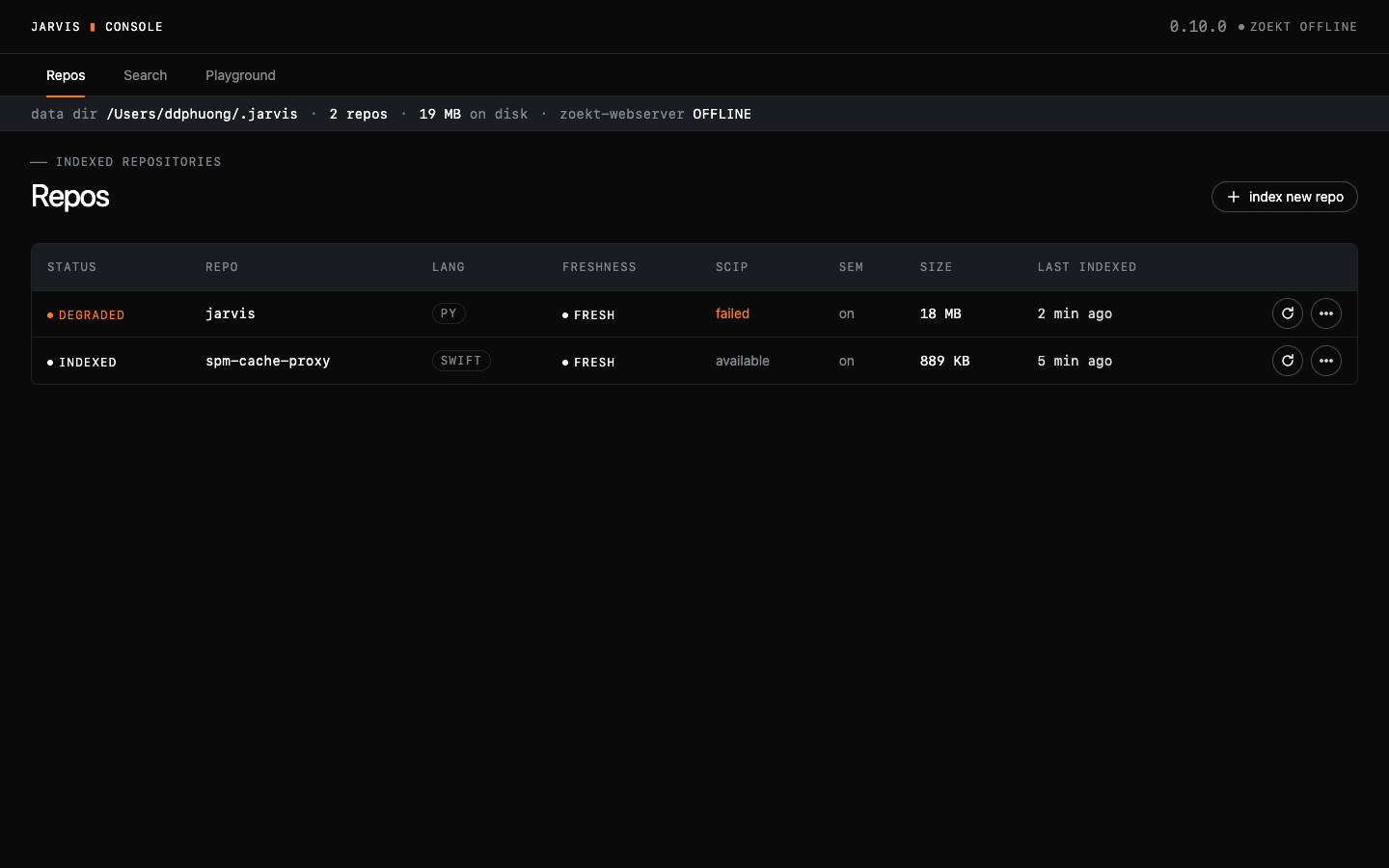
status (as shown by both list and status) is one of indexing (run in progress), indexed (baseline published, SCIP usable/disabled/unsupported), partial (published, but the snapshot has documented syntax/SCIP extraction gaps), degraded (published, but the enabled SCIP stage failed, is missing, or is watch-suppressed — exit 0, cause and jarvis reindex <slug> --scip recovery recorded), or failed (a required stage/storage/publication failure — nothing new published; the previous snapshot stays live).

--semantic-include is repeatable — pass it once per path prefix to force-include several. Like --scheme and --language, once set there is no flag to clear it; change it by re-running jarvis index with the new value(s).

Language detection counts source files by extension across git-tracked files and picks the winner — one language per index:

ExtensionsIndexer
.ts .tsxscip-typescript
.pyscip-python
.java .ktscip-java
.swiftscip-swift

Ties break by fixed priority (.ts.tsx.py.java.kt.swift). .git, node_modules, .venv, __pycache__, dist, and build are skipped. Reading git rather than walking the filesystem is deliberate: a walk also counts gitignored scratch directories, which can outnumber a repo's own code and pick a language it doesn't use.

The pipeline then runs in stages: capture tracked files and build the syntax baseline (scratch) → optional SCIP indexer + scip expt-convert (failures degrade to exit-0, never blocking the baseline) → zoekt-index into ~/.jarvis/.zoekt (its failure fails the run) → optional semantic embeddings → graph edge update → publish everything as one immutable ~/.jarvis/scip/_/<slug>/_/index-<sha>-<generation>.db snapshot → atomic current pointer flip → registry update → old snapshots retired.

The scip/_/<slug>/_/ path shape reuses the vendored IndexConnectionCache's (project, repo, branch) 3-tuple layout with the outer two pinned to _ (see src/jarvis/config.py). It is not a user-facing contract — only <slug> matters when calling tools.

Swift indexing works end-to-end. It requires scip >= v0.9.0: older converters cannot read scip.proto's typed_range oneof, which is the only range encoding scip-swift emits, and silently produce an index with no navigable positions. jarvis index refuses an older scip rather than publishing one.

Indexing a Swift repo with code-signed app-extension targets additionally requires scip-swift >= v0.1.2: earlier versions pass no code-signing overrides to xcodebuild, which then fails provisioning for every signed target before compiling anything. Because setup.sh skips any dependency that is merely present, an existing install is not upgraded by re-running it — use sh ./setup.sh --only scip-swift --force.

Watching a repo (auto-reindex)

jarvis watch /path/to/your/repo             # debounce defaults to 5s
jarvis watch /path/to/your/repo --debounce 3
jarvis watch /path/to/your/repo --scheme MyScheme
jarvis watch /path/to/your/repo --language python
jarvis watch /path/to/your/repo --no-scip   # persist SCIP-off for this repo

Each debounced reindex runs the same staged pipeline as jarvis index. When a SCIP attempt already failed at the current commit, a watch run skips only that SCIP retry (the syntax baseline still publishes); a new commit, an explicit jarvis reindex, or an explicit --scip retries enrichment.

Runs in the foreground (not a daemon) using watchdog — install it with the watch extra. A burst of file changes (e.g. an editor's atomic save touching several files) coalesces into exactly one reindex. The reindex fires once --debounce seconds (default 5) have passed since the last file change — this prevents thrashing on rapid edits. .git, node_modules, .venv, __pycache__, dist, and build are ignored.

Tool details

  • getIndexStatus takes an optional repo_path (the repo's local git working directory) to compare the published commit against git rev-parse HEAD. Omitted, freshness is reported without a staleness check — never stale: true without evidence.
  • searchCode takes query plus an optional repo filter. On first call it lazy-spawns an embedded zoekt-webserver (pidfile'd so a second jarvis process reuses it instead of spawning a duplicate; killed on clean exit via atexit).
  • blastRadius takes repo plus symbol_or_package (e.g. "npm:@scope/ name", the same "{manager}:{name}" string jarvis index derives from each repo's SCIP symbols). Returns every other indexed repo whose package depends on it, up to 2 hops, each tagged with its hop distance. The package graph has no per-node timestamp, so freshness is always "unknown" here — an honest limitation of the schema, not a bug. Cross-repo edges resolve by exact package name against whatever has already been indexed: index the dependency first, or re-run jarvis index/reindex after indexing it, for an edge to appear. Each reindex retracts that repo's own stale edges before recomputing them, so a removed dependency's edge disappears too — the graph always reflects each repo's last index run, not an accumulation of every run it's ever had.
  • semanticSearch takes repo plus a natural-language query. Requires the optional semantic extra. Results fuse a LanceDB vector search over tree-sitter-chunked code with searchCode's Zoekt hits via reciprocal rank fusion. Raises a clear error if the repo has never been indexed with the extra installed (jarvis reindex <slug> after installing it builds the missing table); indexing itself is non-fatal — a failure there never blocks the rest of jarvis index. Semantic indexing also respects .gitignore (on top of the hardcoded ignore-directory list) and skips any file over 1 MB, in addition to the existing generated-file banner/long-line detection — --semantic-include overrides all three.

Known upstream limitations

These are real behaviors of the underlying SCIP tooling (scip expt-convert as of v0.9.0, scip-java, scip-kotlinc), not jarvis bugs:

  • typeHierarchy returns an explicit {"error": ...}, not empty arrays, on indexes built with an unpatched upstream scip — that converter declares global_symbols.relationships in its schema but never writes it. An empty result would wrongly assert "no supertypes"; the error says "cannot tell" instead. setup.sh installs a fork build carrying the fix, so a fresh jarvis reindex <slug> makes the tool work. Reported upstream: scip-code/scip#464, fix scip-code/scip#465 (open, CI green).
  • displayName / kind are backfilled from the symbol string. The converter never populates global_symbols.display_name/.kind, so query.py's _display_and_kind parses both from the SCIP symbol string whenever the database columns are empty (which they still normally are) — documentSymbols returns real values in practice; only a genuinely unparseable symbol falls through to null.
  • searchCode's repo filter matches Zoekt's own repository name, which jarvis index now names after the slug via zoekt-index -meta — so this no longer diverges for repos indexed with current code. Shards published by an older jarvis still carry their old directory-derived name until you jarvis reindex <slug>.
  • scip-java can't index Android/Gradle repos at all — its Gradle plugin keys off Gradle's standard source sets, which AGP replaces with its variant model, so the build emits zero SCIP shards (scip-java#177).
  • Kotlin indexing requires an exact Kotlin version matchscip-kotlinc is compiled against one pinned Kotlin release (SCIP_JAVA_KOTLIN in setup.sh, currently 2.2.0); its compiler-plugin API is internal and unstable even across patch releases, so any other version fails. Both cases are detected automatically from the indexer's own failure output and degrade to exit-0 degraded (SCIP skipped, syntax baseline still published) rather than failing outright.
  • Maven-built Java repos need bash >= 4.4 on macOS — scip-java's generated javac wrapper (#!/usr/bin/env bash, set -eu) expands "${LAUNCHER_ARGS[@]}" unguarded, which errors on bash < 4.4; macOS ships only 3.2, so the build dies at default-compile with LAUNCHER_ARGS[@]: unbound variable. setup.sh works around it by linking first on PATH for the indexer. If no bash >= 4.4 is installed, indexing fails with the remedy rather than degrading — unlike the two cases above, this one is fixable (brew install bash).

Configuration

Data directory (default ~/.jarvis):

JARVIS_DATA_DIR=/custom/path jarvis index /path/to/repo

Environment variables:

  • JARVIS_DATA_DIR — override default ~/.jarvis for all indexes and registry
  • JARVIS_FALLBACK_SEARCH_ONLYremoved. No longer read; jarvis prints a one-line note if your shell still exports it. Replaced by the reversible persisted --scip/--no-scip flags on index/reindex/watch.
  • JARVIS_EMBEDDING_QUERY_PREFIX / JARVIS_EMBEDDING_DOC_PREFIX — override the query/document instruction prefix applied before embedding. Auto-detected for bge-m3, e5, and nomic-embed; set these if using a different model that needs one — semanticSearch warns when an unlisted model has no prefix configured.

Agent skills

Three agent skills ship in the Claude Code plugin, under plugin/skills/:

  • jarvis-setup — install, register, index, verify.
  • jarvis-use — prefer jarvis for structural queries (find references, go-to-definition, hierarchy).
  • jarvis-issues — file jarvis bugs/features via gh.

Install them, and register the MCP server, with:

/plugin marketplace add jarvis-intelligence/jarvis-index
/plugin install jarvis@jarvis

See Quick start above for the manual registration alternative.

Standards

Blob decoding follows the SCIP protocol: scip_pb2.py is generated from scip.proto at scip-code/scip tag v0.9.0 (regenerated up from v0.7.0, which lacked the typed_range oneof scip-swift requires), and occurrence/relationship blobs are decoded as real scip.Document / scip.SymbolInformation messages.

The SQLite layer (documents, chunks, global_symbols, mentions, defn_enclosing_ranges) is not part of that published spec — it is the output shape of the experimental scip expt-convert sub-command, verified by hand against a real index. Treat it as a moving target across scip releases.

Tests

uv run pytest

Integration tests that shell out to the real scip-python / scip / zoekt-index binaries are marked integration:

uv run pytest -m "not integration"   # unit only
uv run pytest -m integration         # real-binary pipeline

Documentation

All 4 planned phases are shipped — see plans/0724-2316-jarvis-mcp-implementation/plan.md.

License

MIT