
 @navid-kianfar
dsh-tasks-manager
DeepSeek Harness plugin: a project task board kept with the project as a queryable SQLite file, with a kanban/list view in the Web Client, model-facing task tools, and cards you can dispatch to the agent as background jobs.
- Stars
- 1
- Language
- TypeScript
- Created
- Aug 26, 2026
- Updated
- Sep 15, 2026
Introduction
@achasoft/dsh-tasks-manager
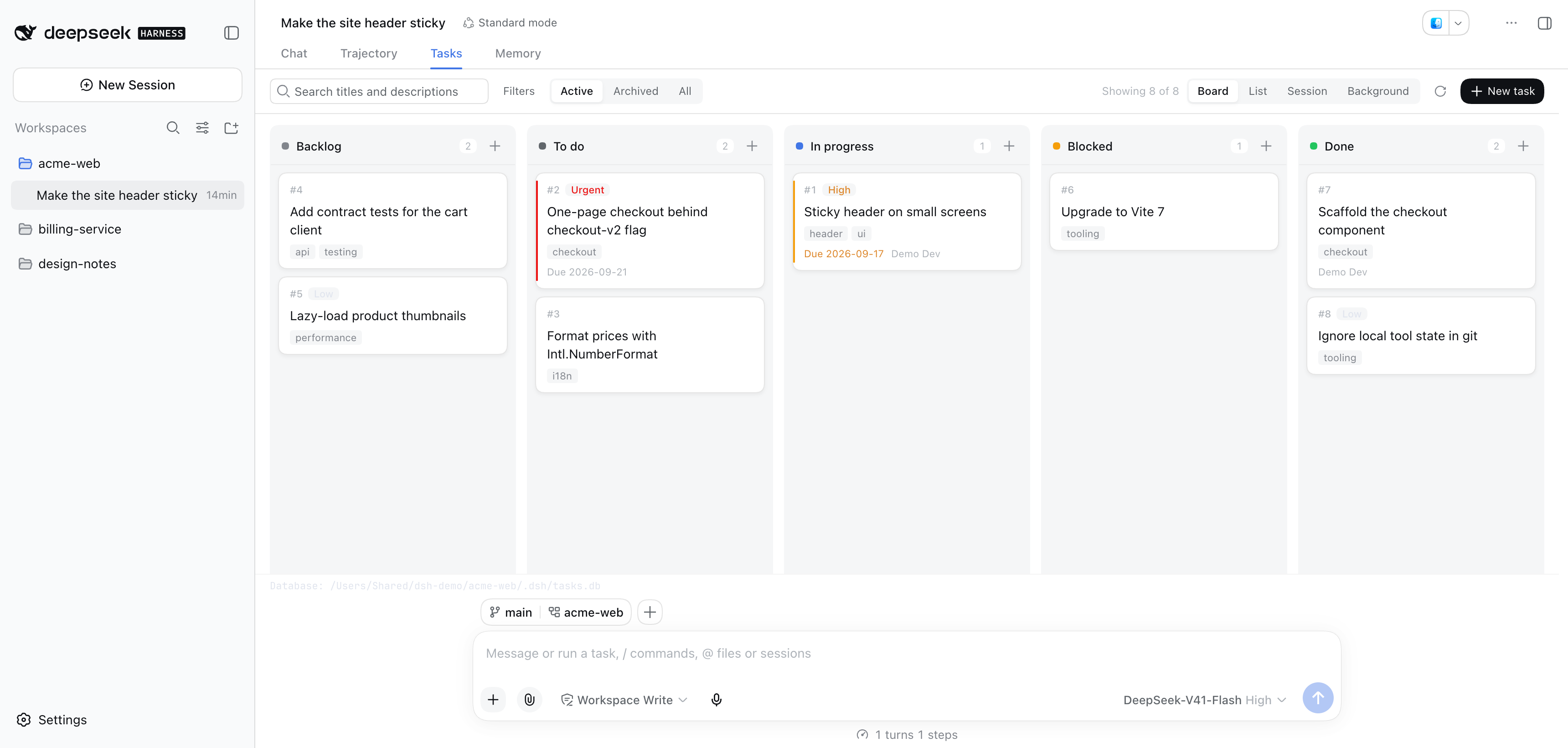
A project task board for the DeepSeek Harness (dsh). Each project gets a SQLite database at <project>/.dsh/tasks.db. The Web Client gets a Tasks tab with a kanban board, a list view, the session's todo_write checklist, and a panel of background jobs. The model gets tools to add, list, update, and comment on cards. When a subagent provider is configured, you can dispatch a card to run as a background job; the result is recorded on the card.
Features
The Tasks tab
A Tasks tab sits beside Chat and Trajectory in every session and shows the board of that session's project. The toolbar switches between four layouts (Board, List, Session, Background) and has a search box (titles and descriptions), a Filters menu (status, priority, labels, assignee, active/archived/all), Refresh, and New task. The footer shows the database path.
- Board: five columns (
backlog,todo,in_progress,blocked,done) with drag and drop between and within columns, a quick-add per column, and a per-card menu (Open, Dispatch to agent, Stop the background run, Archive or Restore, Delete permanently). - List: one row per card, sortable by column.
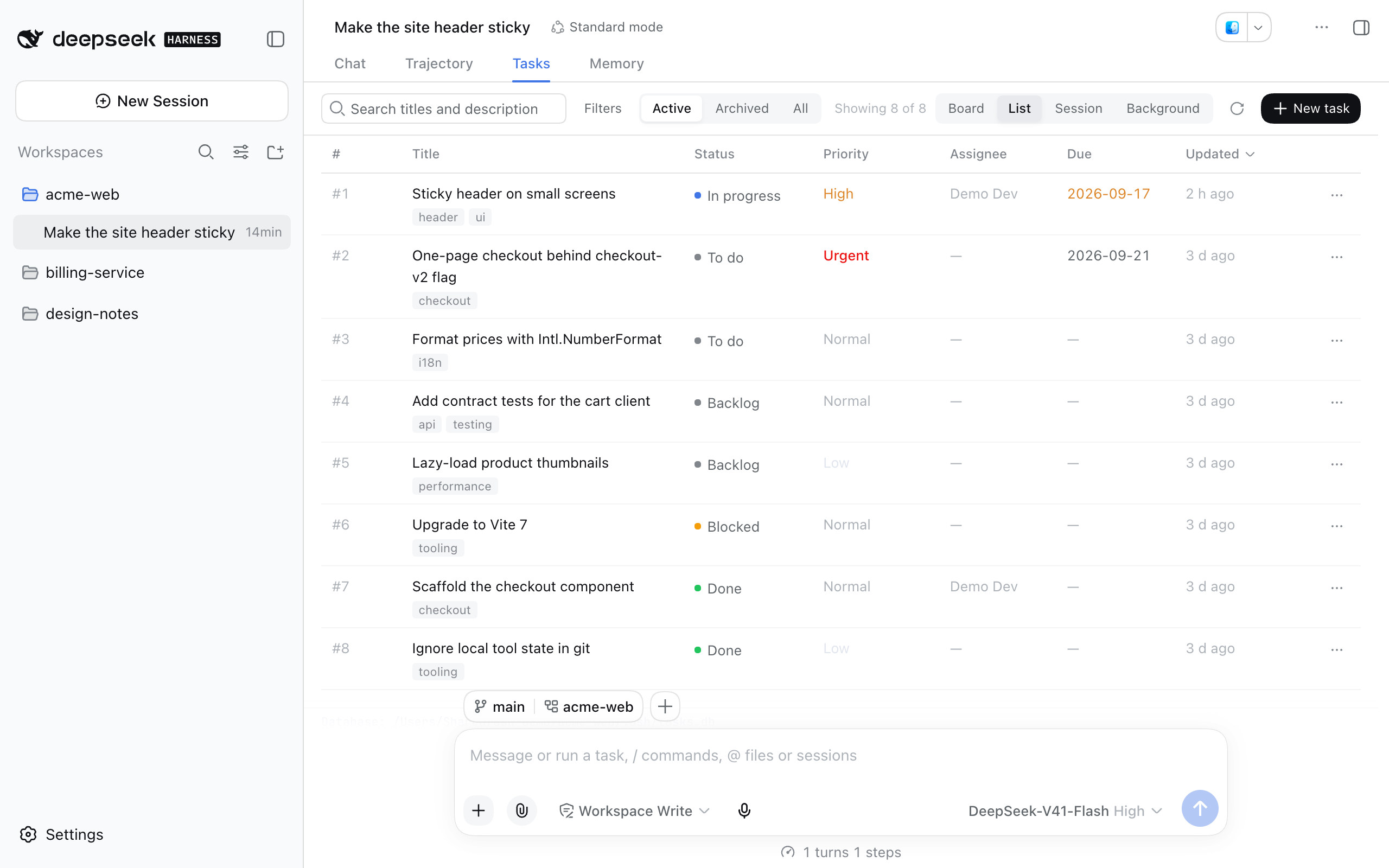
The open board polls a revision counter every pollIntervalMs and re-reads cards only when it changes. Changes made by the agent, another session, another dsh process, or sqlite3 therefore appear without a reload.
Card detail
Opening a card shows an editable title, a Markdown description, status and priority pickers, a due-date calendar, label chips completed from labels already on the board, comments you can edit and delete, a History of every change, and the last run's outcome.
The Assignee picker lists people who have committed to the project, from git log (last 5,000 commits), ranked by commit count, with the identity from git config user.email marked you. A value already on a card that is not in the history stays selectable. In a directory without git history, the picker says so.
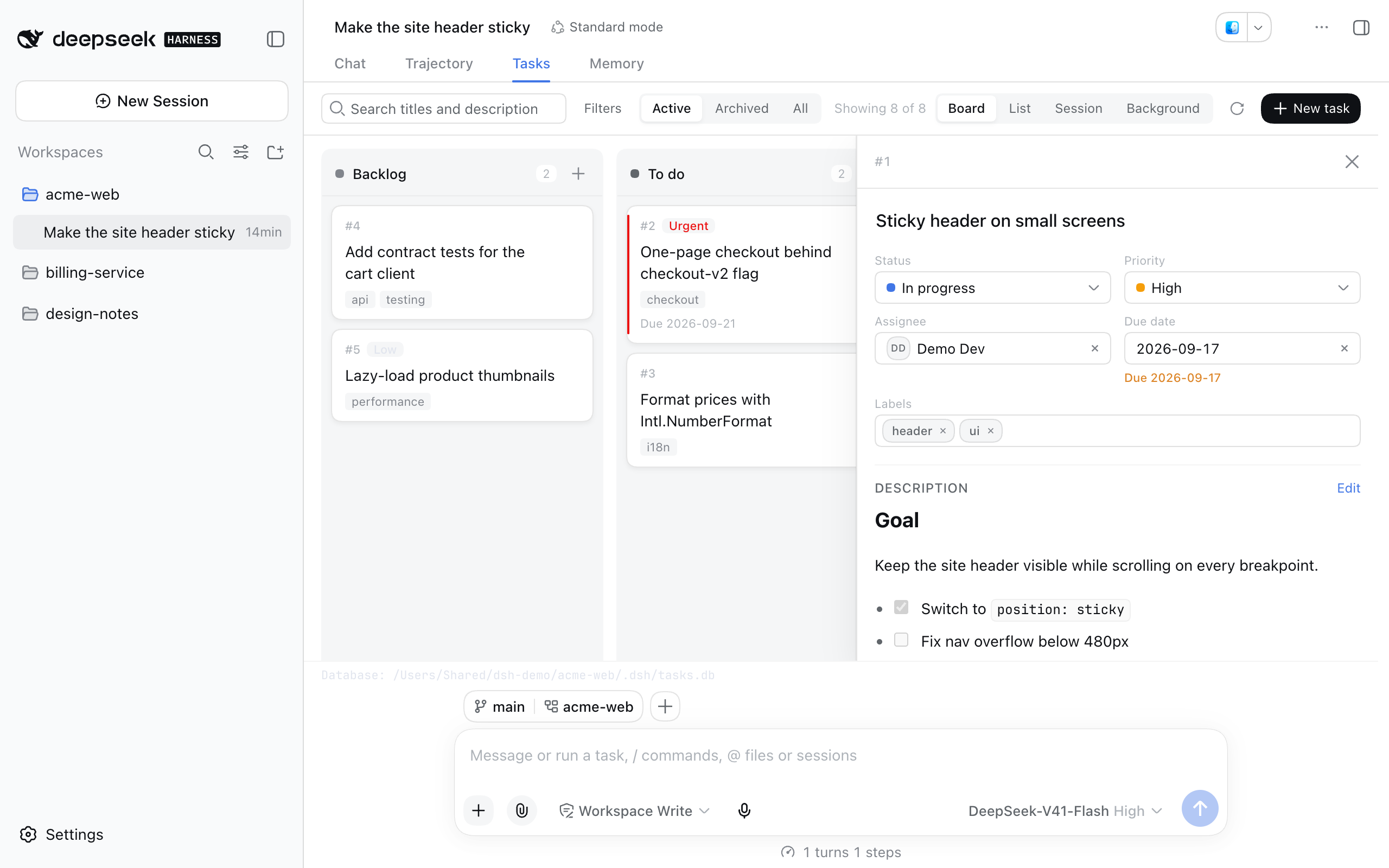
Field edits made in the detail, and moves on the board (drag or keyboard), are sent with the card's updatedAt as it was when the change began: when you entered the title or opened the description editor, or picked the card up. Your own earlier edits to the card carry that stamp forward. If anyone else changed the card in the meantime, the change is refused, the board shows the message, and the board and card reload.
Session checklist
The Session layout shows the checklist the assistant keeps with todo_write for this session, with progress, and an Add to board action that copies an unfinished step onto the board.
Background jobs and dispatch
The Background layout lists every background job the session can see: shell commands, subagents, and dispatched cards, with status, elapsed time, and a Stop control. Read output shows a dispatched card's final report. For other job kinds the output is withheld, because the job registry has one consuming read cursor per job, and that cursor belongs to the agent's job_output.
When subagentProvider is set, Dispatch to agent starts the card as a background job on that subagent provider. The prompt includes the card's title, status, priority, labels, assignee, description, and comments. While it runs:
- the card shows Running with a stop control, and moves to
dispatchStatus; - the owning agent is not woken when the run finishes (the plugin holds the job's completion notice), but
job_listandjob_outputstill show it.
When it ends, the card's last run records the status (completed, failed, or killed). The subagent's output, or for a failed run its diagnostic and partial output, is added as a comment and returned by job_output. On completed, the card moves to dispatchCompletedStatus unless that is none. The outcome is recorded by database path, so it still reaches the card after a settings save or plugin reload.
Deleting a running card first stops its run, acting as the session that owns the job. If the run belongs to another live dsh process, the delete is refused.
A card marked running by an older build of this plugin shows Running (owner unknown): that marker does not say which dsh process owns the run, so it is never cleared automatically. Its stop control becomes Clear the running marker, and Dispatch to agent and Delete stay available; each of the three asks you to confirm first, because the old run may still be going in another dsh process, and clearing the marker does not stop it there. See Run ownership.
Settings card
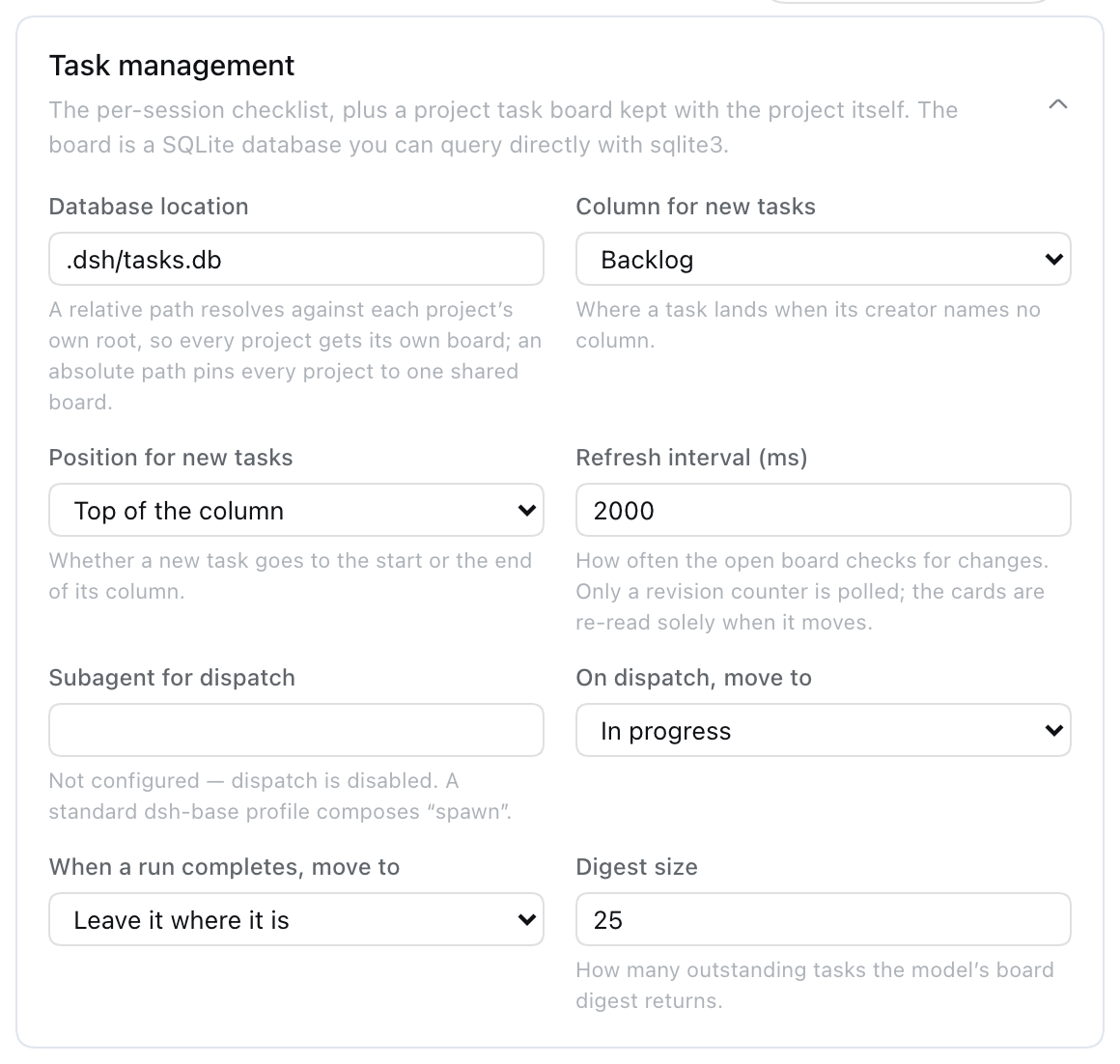
Settings → Plugins → Task management edits the fields marked in Configuration.
Requirements
- Harness: tested with
@deepseek-ai/dsh0.1.5-rc.2. - Node.js:
^22.19 || >=24(enginesinpackage.json). The board uses the built-innode:sqlitemodule (DatabaseSync); there is no native dependency to install. Some Node versions print anExperimentalWarningfor it. - pnpm on
PATH:dsh pluginforwards to it. - git on
PATH(optional): only needed for the assignee picker. - Harness services: peer dependencies are
@deepseek-ai/cordis,dsh-agent,dsh-client-connection,dsh-host-apiproxy,dsh-jobs,dsh-session,dsh-tool-todo,dsh-tools,dsh-typert-protocol, andschemastery. Every host-side service is read optionally, and features degrade when it is absent:
| Service | Provided by (standard dsh-base / web profile) | Without it |
|---|---|---|
sessions | core harness | The RPC channel resolves only sessions found through persistence. |
agents | core harness | Dispatch fails. |
sessionPersistence | dsh-session-persistence-jsonl | A tab on a session that is no longer live cannot find its board. |
connection, webServer | web profile | No /dsh-tasks RPC channel (headless); tools still work. |
jobs | dsh-jobs-local | Dispatch and the Background layout are unavailable. |
subagents + a named provider | dsh-subagent-* (spawn, fork in dsh-base) | Dispatch is hidden. |
todos projection | dsh-tool-todo | The Session layout says the checklist is unavailable. |
settings | dsh-settings-file | No Settings card or live edits; the patch row is used. |
The browser half needs dsh-api-remotes, dsh-client-locale, dsh-client-ui-conversation, dsh-client-ui-layout, dsh-client-ui-settings, dsh-client-ui-settings-plugins, and dsh-client-ui-sidebar.
Install
dsh plugin --profile web add @achasoft/dsh-tasks-manager
dsh web
dsh plugin --profile <name> <args> runs pnpm <args> in $DSH_HOME/profiles/<name> ($DSH_HOME defaults to ~/.dsh) and creates the profile on first use. After a successful add, any dependency whose package.json declares dsh.bundle is appended to dsh.profile.bundles.
At boot the harness composes the profile from patch layers, in this order: each bundle's cordis.patch.yml, the profile's own cordis.patch.yml, $DSH_HOME/cordis.patch.yml, then --patch <file> overlays. This package's patch inserts three rows, all enabled:
Row id | Loads |
|---|---|
tasks | @achasoft/dsh-tasks-manager/host: the board, the RPC channel, settings, dispatch |
tasks-tools | @achasoft/dsh-tasks-manager/tools: model-facing tools |
tasks-ui | @achasoft/dsh-tasks-manager: the browser half |
To enable dispatch, set subagentProvider in the Settings card or in a patch (see below).
To keep the board for people but give the model no access, disable the tools row:
- id: tasks-tools
  disabled: true
To uninstall:
dsh plugin --profile web remove @achasoft/dsh-tasks-manager
Remove any rows in your own patch files that target the ids above. .dsh/tasks.db files in your projects are left in place.
Configuration
Override a row from your profile's cordis.patch.yml by id. A patch replaces the row's whole config, so restate every key:
- id: tasks
  config:
    databasePath: .dsh/tasks.db
    projectRootMarkers:
      - .git
    defaultStatus: backlog
    newTaskPlacement: top
    journalMode: wal
    busyTimeoutMs: 5000
    pollIntervalMs: 2000
    subagentProvider: spawn
    dispatchStatus: in_progress
    dispatchCompletedStatus: none
    digestSize: 25
The patch row is the base layer. Values saved from the Settings card go to the harness settings layer (the tasks: section of $DSH_HOME/settings.yaml) and take precedence. Saving a change closes and reopens every open board.
tasks row
| Key | Default | In Settings card | What it does |
|---|---|---|---|
databasePath | .dsh/tasks.db | yes | Relative paths resolve against the project root. An absolute path makes every project share one board. |
projectRootMarkers | ['.git'] | no | Entry names looked for from the session directory upwards. The first match is the project root; with no match, the session directory is the root. |
defaultStatus | backlog | yes | Column for a card created without one: task_add without status, Add to board from the checklist, and the toolbar's New task composer. When a status filter hides this column, the composer uses the first filtered column so the card stays in view. A column's own quick-add always uses that column. |
newTaskPlacement | top | yes | top or bottom of the column. |
journalMode | wal | no | wal, delete, truncate, or persist. |
busyTimeoutMs | 5000 | no | How long a write waits for another writer. |
pollIntervalMs | 2000 | yes | Revision poll interval for an open board; minimum 250. |
subagentProvider | '' | yes | Subagent provider name for dispatch. Empty hides dispatch. |
dispatchStatus | in_progress | yes | Column a card moves to on dispatch; none leaves it. |
dispatchCompletedStatus | none | yes | Column a card moves to when its run completes; none leaves it. |
digestSize | 25 | yes | Cards task_list returns with sort: urgency and no limit; 1–200. |
tasks-tools row
| Key | Default | What it does |
|---|---|---|
allowDelete | false | Registers task_delete. Archiving is recoverable; deleting is not. |
defaultListLimit | 50 | Cards task_list returns with no limit; 1–200. |
Neither key is editable in the Settings card.
Model-facing tools
Tools resolve the board from the calling agent's session directory. Cards can be referred to as #12, 12, or the full t_… id. Tool writes are recorded in history as agent.
| Tool | What it does |
|---|---|
task_add | Add one or more cards in one transaction (title, body, status, priority, labels, assignee, due date YYYY-MM-DD). |
task_list | Read the board with filters (status, priority, labels, assignee, search, archived, limit). sort: urgency returns only unfinished, unarchived cards, most pressing first. |
task_update | Change title, body, status, priority, labels (replaces the set), assignee, due date, or archived. |
task_comment | Add a Markdown comment. |
task_delete | Permanently delete a card, its comments, and history, stopping any run first. Refuses a card whose running marker has no recorded owner; a person clears that marker on the board. Registered only with allowDelete: true. |
Limits: title 200 characters, body and comment 20,000, up to 20 labels of 40 characters, assignee 80.
RPC
The browser half talks to the host over the harness's unary RPC channel at /dsh-tasks. The route is mounted on the web server behind the connection's request gate (Host/Origin check and browser token). Every request carries a sessionId; the host resolves the board from that session's working directory, and the browser never sends a filesystem path. Validation errors, unknown cards, and stale edits and moves come back as bad-request.
Endpoints: board.read, board.revision, task.detail, task.create, task.update (optional expectedUpdatedAt), task.move (optional expectedUpdatedAt), task.archive, task.restore, task.delete (optional clearUnknownRun), task.clearRun (taskId, jobId), comment.add, comment.edit, comment.remove, task.dispatch (optional clearUnknownRun), jobs.list, jobs.read, jobs.kill, git.authors.
A card whose running marker records no owner carries runOwnerUnknown: true. task.dispatch and task.delete refuse such a card with bad-request unless clearUnknownRun names the marker's job id, which the browser sends only after the person confirms; task.clearRun clears the marker on its own. A job id that no longer matches the marker is refused, so a confirmation never clears a run the person was not shown.
Data and storage
- Location:
<project root>/.dsh/tasks.db. The directory is created0700and the file0600; an existing file keeps its mode. - Tables:
tasks,comments,activity(per-change history),meta(revision,next_ref), and aboardview for reading by hand:
sqlite3 .dsh/tasks.db "select card, title, status, assignee from board where state = 'active'"
refcomes frommeta.next_refand is never reused, including after a delete.rankis a fractional-index string, so a drag writes one row.meta.revisionis advanced by triggers ontasksandcomments, so every writer moves it, includingsqlite3.- Sharing: several
dshprocesses on one host can use the same board. Each process keeps one handle per database file. Do not run twodshservers against the same$DSH_HOME. - Backups: SQLite's online backup works while
dshis running:
sqlite3 .dsh/tasks.db ".backup tasks-backup.db"
Upgrading an existing board
The layout version is stored in PRAGMA user_version; this build writes version 3. Boards created by the published 0.2.2 and earlier are version 1; version 2 was only ever written by unreleased development builds. The first time this build opens an older board, it upgrades the file in place, in one transaction: it adds the tasks.run_owner column (from version 1), installs the revision triggers and the running-marker guard trigger, and recreates the board view. No rows are dropped or rewritten, and no running marker is cleared by the upgrade.
Copy the file aside before the first start, because the upgrade is one-way:
cp .dsh/tasks.db .dsh/tasks.v1-backup.db
After the upgrade:
- An older build process that already had the board open keeps working and its writes still move the revision. An older build that opens the file afterwards refuses it, because it only reads version 1. A file stamped with a version newer than this build is refused in the same way.
- A running marker written by an older build has no owner. It is kept, shown as Running (owner unknown), and cleared only when you confirm it on the board (Clear the running marker, Dispatch to agent, or Delete), or when this process's own job registry identifies that run and reports it finished (the older build's run in this same process, before a plugin reload). It is not cleared on open, because the older build may still be running it.
- If you clear such a marker and dispatch again while the older build's run is in fact still going, that run's eventual settlement is refused by the guard trigger instead of clearing the new run's marker. The older build logs the failed write and carries on; the new run is unaffected. Stop the older process's run from that process if you do not want two runs of the card.
Run ownership and stale markers
A running card stores running_job_id and run_owner, a JSON object {host, machine, pid, processStart, instance, sessionId}. Markers written by development builds of version 2 have only {host, pid, instance, sessionId} and are still read.
instanceis a random id perdshprocess. It is checked first: a marker with this process's instance is this process's, even if the host name has changed since.machineis a salted SHA-256 digest of the machine's stable id:IOPlatformUUIDon macOS (read once per process with/usr/sbin/ioreg),/etc/machine-idor/var/lib/dbus/machine-idplus the pid namespace on Linux,MachineGuidon Windows (read once withreg.exe). If none can be read, the host name is used instead.hostis still written, for people reading the row, and is compared only for markers withoutmachine.processStartis the owning process's start: ticks since boot plus the boot id from/procon Linux, theps -o lstarttime on macOS (compared within 30 seconds). It is omitted where the platform offers neither, including Windows.
A process clears a marker only when:
- its owner is on this machine, and the owner process has exited, or its pid is now held by a process with a different start time;
- the marker is this process's own run, and the job registry reports the job settled or no longer knows it; or
- the marker has no owner, and either you confirmed clearing it on the board, or this process's job registry holds a
taskjob with the same id, for the same card and dispatching session, started within 10 seconds of the recorded dispatch, and that job has finished.
Markers from another live process are left alone, as are markers whose owner start time cannot be read. Markers owned on another machine are never cleared automatically. To clear one by hand (the board picks it up on the next poll), clear both columns in one statement; a statement that clears running_job_id of an owned marker alone is refused by the guard trigger:
sqlite3 .dsh/tasks.db "UPDATE tasks SET running_job_id = NULL, run_owner = NULL WHERE ref = 12"
Security and trust model
- Git reads are hardened. The assignee picker runs
git --no-pager -c log.showSignature=false -c core.fsmonitor=false -c core.pager=cat -C <root> log --no-show-signature …, plus twogit config --getcalls, with a 5-second timeout and a 4 MB output cap. A repository's own.git/configcannot make opening the board rungpg.programor an fsmonitor hook. Nothing is written to git. Results are cached per project for 60 seconds. - Runs are stopped as their owner. Stop on a job the session can see acts as that session, the same as
job_kill. A card's run started by another session in this process is stopped as its owning session, and only if the job's kind istask. A hand-editedrunning_job_idthat points at someone's shell job cannot be used to stop that job. - Deletes respect other processes. A card whose run belongs to another live process cannot be deleted from this one. A card whose run has no recorded owner is deleted only after you confirm.
- Owner checks run fixed system tools. Besides
git, the host may run/usr/sbin/ioreg(macOS) orreg.exe(Windows) once per process to read the machine id, and/bin/ps -o lstart= -p <pid>(macOS) when judging another live process's marker on this machine. Each runs without a shell, from an absolute path, with a 2-second timeout; the only value taken from the board is the pid, which must be a positive integer. On Linux only files under/proc,/etc, and/var/lib/dbusare read. The machine id is stored only as a salted digest. - The model cannot delete by default.
task_deleteis only registered withallowDelete: true. - Job output is not taken from the agent. The board reads output only for its own
taskjobs, which return final output without consuming the agent's read cursor.
Known limitations
- Markers owned on another machine are never auto-cleared. See Run ownership.
- Markers written by an older build are never auto-cleared unless this process's job registry identifies the run as finished. Clearing one is your call on the board.
- Machines with a cloned machine id (for example VM images that were not re-sealed) look like one machine, so a marker from the other could be swept when its pid is not found locally. Linux containers are told apart by pid namespace.
- Dispatch needs a live session. A tab on a session that is no longer live can read and edit the board but cannot dispatch.
- Board state is not in the session log. An out-of-tree plugin cannot add session event types, so history lives only in
tasks.db.
Development
The devDependencies link a deepseek-harness checkout at ../../deepseek-harness, relative to this repository, for types and tests. pnpm install expects it there.
pnpm install
pnpm run typecheck
pnpm test
pnpm run build        # tsc for declarations, then tsdown for the node and browser bundles
There is no Typert contract to regenerate: the channel's payloads are validated in src/domain/validate.ts and src/host/index.ts.
To run a checkout in a local profile, add it by path and restart the web server:
dsh plugin --profile web add link:/absolute/path/to/dsh-tasks-manager
dsh web
A linked package resolves its imports from its own directory, so the harness packages it imports must resolve there to the same copies the running harness uses. The maintainers' workspace does this with publish-plugins.sh and .dsh-compat/install-plugins.sh in the parent dsh-plugins directory, not in this repository. After a rebuild, restart dsh web.
License
MIT