
 @flykit-cc
dsh-flykit
flykit for DeepSeek Harness — explorer with live file watch, agent terminals (Claude Code, Pi, Codex), DSH agent tools, a searchable model picker and a Claude-Code-style status line. Fly your agents.
- Stars
- 0
- Language
- TypeScript
- Created
- Sep 4, 2026
- Updated
- Sep 18, 2026
Introduction
dsh-flykit
Fly your agents.
A plugin for DeepSeek Harness that turns the
dsh web GUI into an agent cockpit: a file explorer with an editor, real coding-agent terminals,
a searchable model picker, and a status line under the composer.
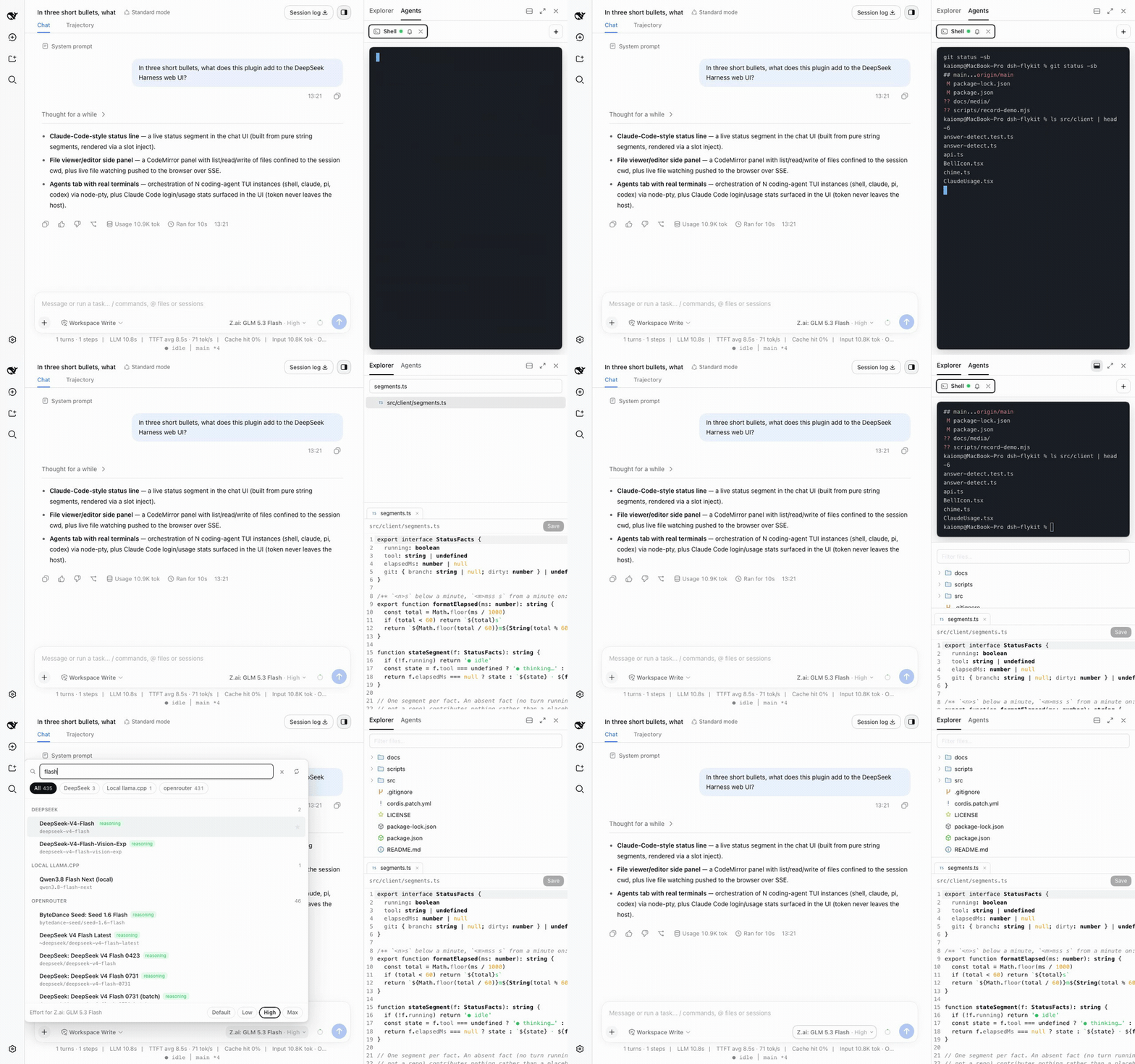
What you get
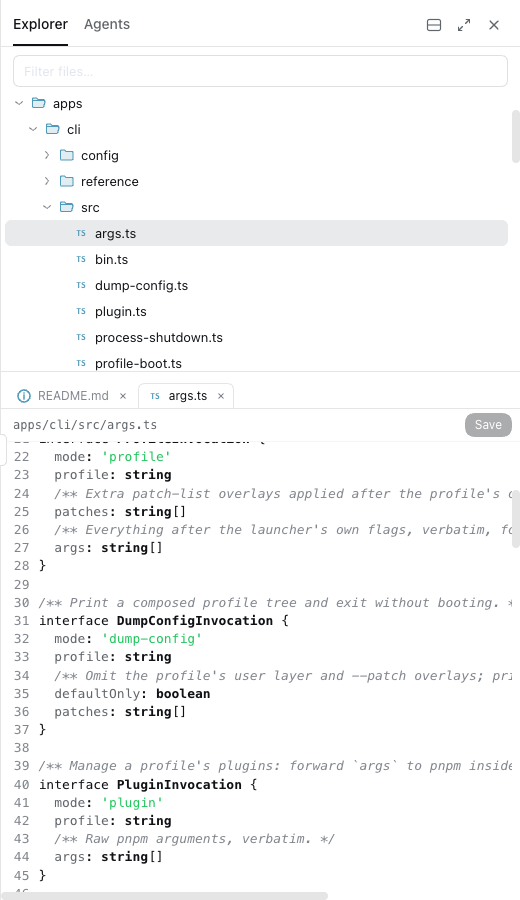
Explorer — the session's file list (git ls-files, or a plain walk outside a repo), a
CodeMirror editor that saves back to disk, Markdown and HTML/SVG preview, and a live fs.watch
that refreshes the tree, dots changed files, and reloads an open file when it changes on disk
(dirty files keep your edits and show a notice instead).
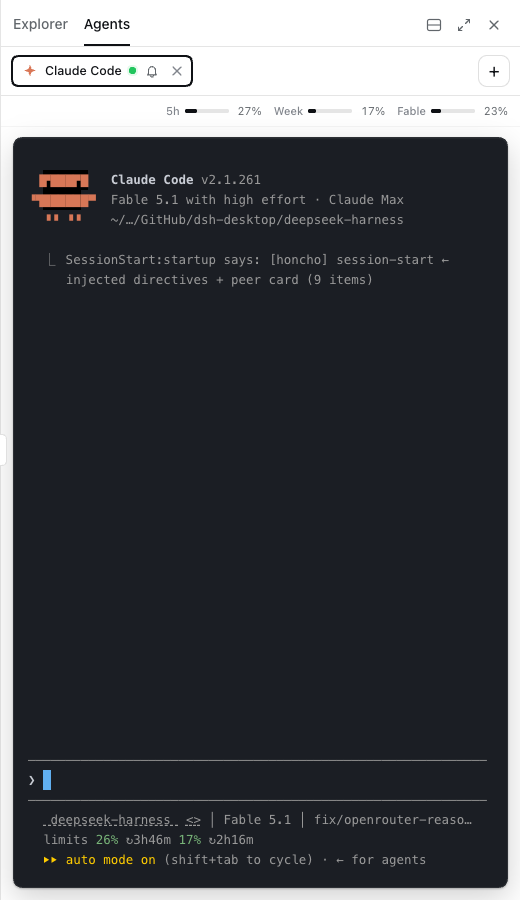
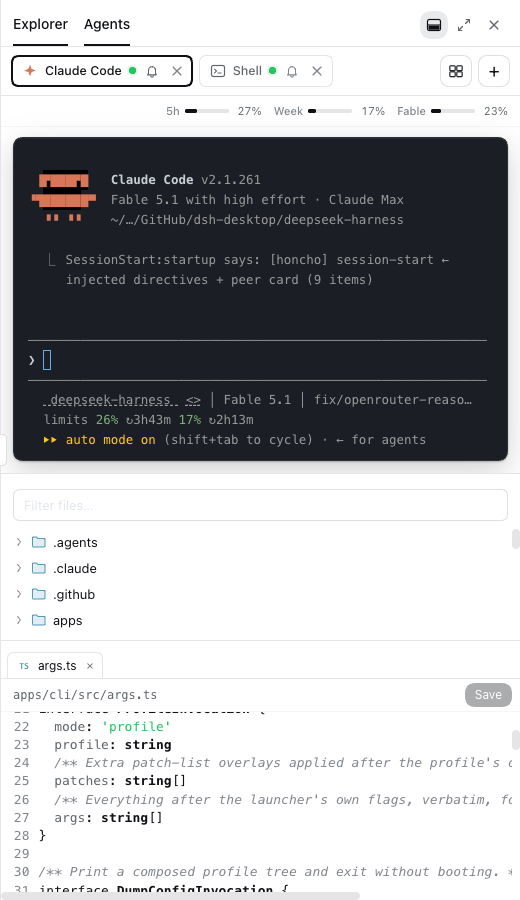
Agents — real PTY terminals in the session's workspace: Claude Code, Pi, Codex, or a plain shell, in an xterm view. A chime and a dot mark the tab when an agent stops printing after a burst of output; per-terminal mute. Claude subscription usage bars appear above a Claude Code terminal.
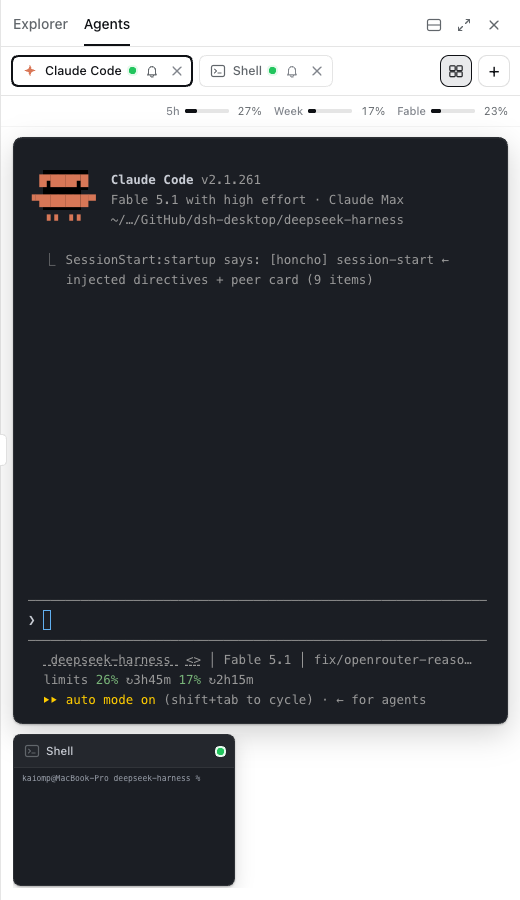
Stage view — the focused agent fills the panel, the others sit under it as live thumbnails.
Split mode — Agents stacked above Explorer, so a running terminal and an open file are visible at once. The panel also maximises to the full window.
Apps — WhatsApp Web inside the panel. A headless Google Chrome owned by the host (apps/whatsapp/)
runs web.whatsapp.com; the tab shows its live CDP screencast and forwards clicks, typing, wheel and
paste. Opening the tab starts that Chrome if it is down. The linked session lives in
~/.dsh/flykit/whatsapp/, outside the package. First time: cd apps/whatsapp && node wa.mjs login
prints the QR in the terminal (the tab shows it too). Details and what was verified: apps/whatsapp/README.md.
Model picker — replaces the shell's model seat with a search box over the same directory
/model uses, so both stay one state. Provider pills, favourites, recents, reasoning badges, an
effort row for reasoning models, and a button that refreshes the OpenRouter catalog live.
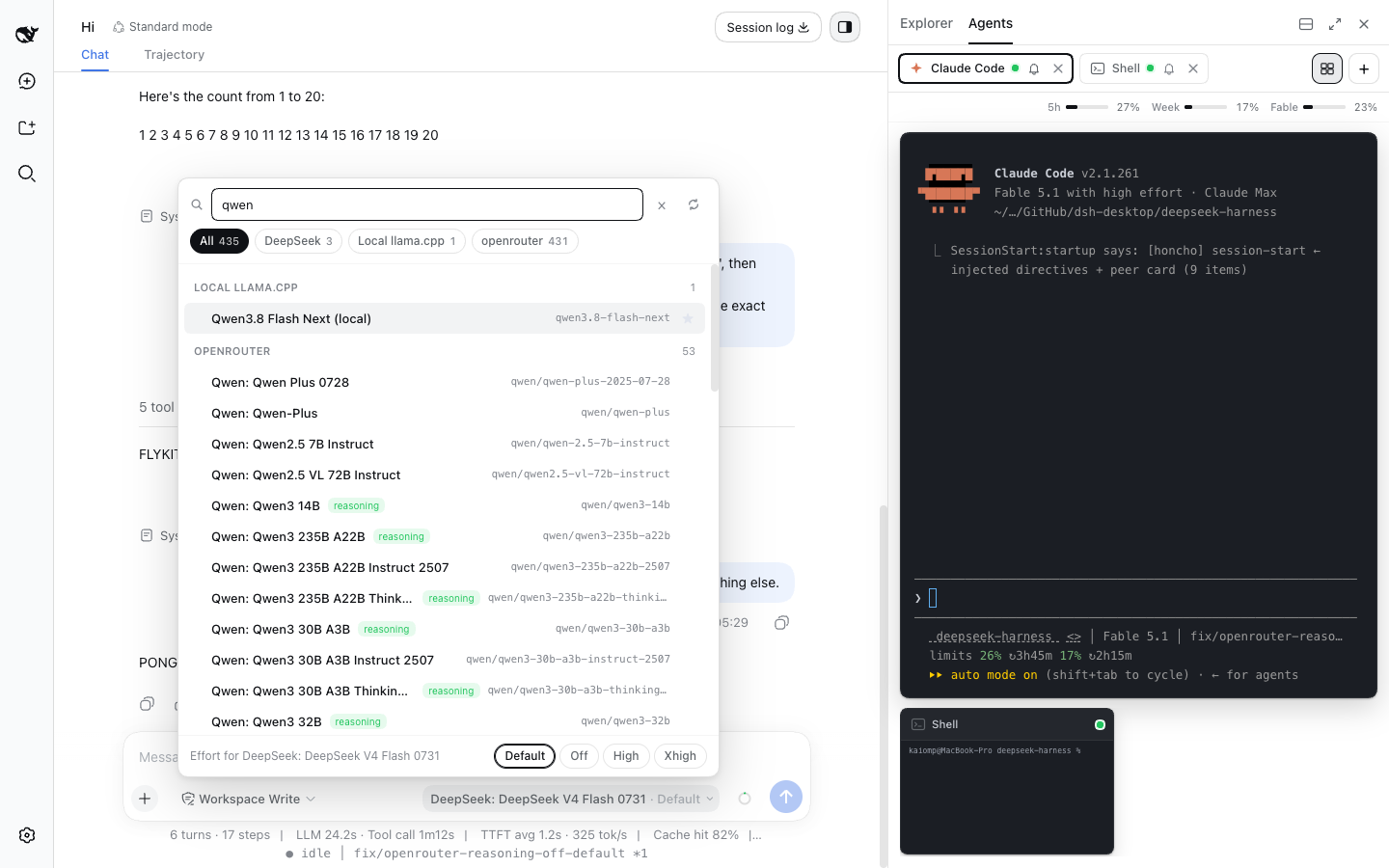
Status line — idle / thinking / running tool, a turn timer, the session's git branch and dirty count. It also recolours the shell's context ring as the window fills.

Agent tools — seven flykit_agent_* tools that let the DSH agent itself open, drive and read
those terminals. See the table below.
Install
From npm:
dsh plugin --profile web add dsh-flykit
From GitHub:
dsh plugin --profile web add github:flykit-cc/dsh-flykit
Or from a checkout:
git clone https://github.com/flykit-cc/dsh-flykit
cd dsh-flykit
npm install && npm run build
dsh plugin --profile web add .
Check the layer landed, then start the GUI:
dsh --profile web --dump-config | grep flykit
dsh web
Remove it with dsh plugin --profile web remove dsh-flykit.
Requirements
- Node ≥ 22
- DSH 0.1.2-rc.1
- macOS or Linux. The Agents tab uses node-pty, a native module; there is no Windows build here.
gitonPATHfor the branch segment and the Explorer's file list (without it, a plain directory walk).claude,piorcodexonPATHfor the terminals that run them. A missing binary just makes that terminal exit.
How it works
One package, two halves:
- Host half (
lib/index.js, a Cordis plugin) runs in thedshprocess. It registers routes on DSH's web server under/api/flykit/*:git,files,file(GET/PUT),watch(SSE),terms,term/input,term/resize,term/screen,term/stream(SSE),claude-usageandcatalog-sync. It also registers the seven agent tools, if the tool registry is present. - Client half (
lib/client.js) is a CommonJS bundle the shell loads in the browser. It injects React components into the shell's slots and reaches the host over those routes withfetchandEventSource. Everything outside the shell's own platform modules is inlined, so the bundle is large.
The routes have no authentication. DSH's web server binds to loopback, and that is the only
thing keeping them private — anything that can reach the port can call them, and term/input
writes to a live shell. Two limits do apply: the working directory always comes from the session
header, never from the request, and file reads and writes are confined below it. Do not expose
dsh web on a public interface with this plugin installed.
Catalog sync writes your settings. If llm-pi-ai already has an openrouter provider
configured, flykit fetches openrouter.ai's live model list three seconds after boot and once a day
after that, and writes it to llm-pi-ai.providers.openrouter.models through the settings service
— replacing whatever list is there. A short answer (under 50 models) is discarded rather than
written, but there is no undo and no backup: backing up your settings is your job. With no
openrouter provider configured, nothing is written.
Agent tools
Available to the DSH agent when dsh-tools is in the composition. Every tool is scoped to the
calling session — one session never reaches another's terminals.
| Tool | What it does |
|---|---|
flykit_agent_start | Open claude, pi, codex or shell in the session's workspace; returns once the TUI has drawn itself, so the first send is not swallowed. |
flykit_agent_send | Type text into a running terminal; presses Enter unless enter: false. |
flykit_agent_read | Read a terminal as plain text, colours and redraws resolved. sinceSeq returns only what is new. |
flykit_agent_wait | Wait for the terminal to go quiet, then return what it printed. This is how an answer is collected. |
flykit_agent_list | List this session's terminals, running or exited. |
flykit_agent_stop | Kill a terminal and remove it from the panel. |
flykit_agent_run | One headless question to claude or pi in this workspace; no terminal, no follow-up. |
Privacy
The usage bars read the Claude Code login already on this machine — the macOS Keychain entry
Claude Code-credentials, or ~/.claude/.credentials.json elsewhere — and call Anthropic's usage
endpoint from the host process. The OAuth token never leaves that process and is never sent to the
browser; the browser receives only the plan name, the percentages and their reset times. With no
Claude Code login present, the bars stay hidden.
The Apps tab runs WhatsApp Web in a separate headless Chrome on this machine; its CDP port (9222)
and viewer (9223) bind to 127.0.0.1 only, and the linked WhatsApp session is stored under
~/.dsh/flykit/, never inside the package or a repo.
The only other network call flykit makes is the OpenRouter catalog fetch described above. File
contents, terminal output and git status stay between the dsh host process and your browser.
Development
npm install
npm run dev                         # tsdown --watch: client bundle hot-reloads
dsh plugin --profile web add .      # once
dsh web --port 3080 --no-open
Client bundle edits reload in the browser; host-half edits need dsh web restarted.
npm run typecheck and npm test cover both halves — the test run also verifies the client bundle
registers exactly one module and pulls in no non-platform imports.
Status
0.1.0, and rough in places:
- Not published to npm yet; install from GitHub.
- The routes are unauthenticated (see above).
- Terminals live in the host process. Restarting
dsh webkills them; scrollback is capped at 256 KiB per terminal. - The Agents tab polls the terminal list every two seconds rather than streaming it.
- The file list stops at 5,000 entries and the editor refuses files over 2 MiB.
- The editor is CodeMirror with syntax highlighting only: no language server, no diff view.
- The model picker shadows the shell's shipped model seat. Removing the plugin restores it.
License
MIT. flykit.cc