
 @PerryLink
dsh-plugin-upgrade
Plugin-author upgrade skill for DeepSeek Harness: one package, one corridor index - it detects the caller peer band, routes to the matching closed corridor card (0.1.3-alpha.1 -> 0.1.5-rc.1, 0.1.5-rc.2 -> 0.1.6-alpha.2) and runs a zero-dependency seam scanner as a bundle skill + npx CLI.
- Stars
- 2
- Language
- JavaScript
- Created
- Sep 19, 2026
- Updated
- Oct 19, 2026
Introduction
⬆️ dsh-plugin-upgrade
- 1024 store channel:
npm i -g dsh1024once, thendsh1024 plugin --profile web add dsh-plugin-upgrade(counts toward the deepseek1024.com install ranking).

Plugin upgrade skill for DeepSeek Harness — one package, one corridor index, two closed corridors: 0.1.3-alpha.1 → 0.1.5-rc.1 (legAB) and 0.1.5-rc.2 → 0.1.6-alpha.2 (legC).
The scanner routes itself: it reads the target repository's declared dsh band (or takes --span), then applies that corridor's own evidence-bound catalog — legAB's 20 seams (leg A 0.1.3-alpha.1 → 0.1.5-alpha.1 plus leg B 0.1.5-alpha.1 → 0.1.5-rc.1) or legC's 5 seams (E1–E5). One entry point, so a client half that stopped mounting silently is never mistaken for "typecheck is green".
Official repository. This is the only official repository of dsh-plugin-upgrade, maintained by PerryLink. It supersedes the retired version-locked packages
dsh-plugin-upgrade(leg A) anddsh-plugin-upgrade-rc1(leg B), and it is the package the0.1.5-rc.2→0.1.6-alpha.2corridor (leg C) was folded into — thedsh-plugin-upgrade-016name never reached the registry. Bothdsh-plugin-upgrade-015anddsh-plugin-upgrade-016are retired as of 2026-10-05 and receive no further fixes, releases or security updates; every plugin upgrade continues here, and the corridor is chosen by the version the target repository declares for itself, so no version-locked package per host hop is needed. Same-name repositories under other accounts are not affiliated.








English · 简体中文 · Español · Português · हिन्दी
dsh plugin --profile <name> add dsh-plugin-upgrade
📖 Ecosystem knowledge base — measured data, not marketing: plugin development guide · plugin-selection data · maintenance criteria.
Install & uninstall
dsh plugin --profile web add dsh-plugin-upgrade            # from npm
dsh plugin --profile web add github:PerryLink/dsh-plugin-upgrade   # from source
dsh plugin --profile web remove dsh-plugin-upgrade         # uninstall (reversible)
Installing the bundle only registers a skill; removing the row removes the skill. The CLI is a normal npx target and needs no profile at all.
⭐ 如果它帮到了你
这个插件是 DSH 插件家族的一员(95 个,全部 Apache-2.0)。如果你在用,给个 star —— 它不会解锁任何功能,但会让下一个人在搜索里更容易找到它。
English: part of a 95 plugin family for DeepSeek Harness. If it is useful, a star helps the next person find it — nothing is gated behind it.
What is dsh-plugin-upgrade?
Plugin upgrade skill for DeepSeek Harness — one package, one corridor index, two closed corridors: 0.1.3-alpha.1 → 0.1.5-rc.1 (legAB) and 0.1.5-rc.2 → 0.1.6-alpha.2 (legC).
The scanner routes itself: it reads the target repository's declared dsh band (or takes --span), then applies that corridor's own evidence-bound catalog — legAB's 20 seams (leg A 0.1.3-alpha.1 → 0.1.5-alpha.1 plus leg B 0.1.5-alpha.1 → 0.1.5-rc.1) or legC's 5 seams (E1–E5). One entry point, so a client half that stopped mounting silently is never mistaken for "typecheck is green".
Workflow overview: call → plugin → result. The examples below use the real command surface.
Comparison
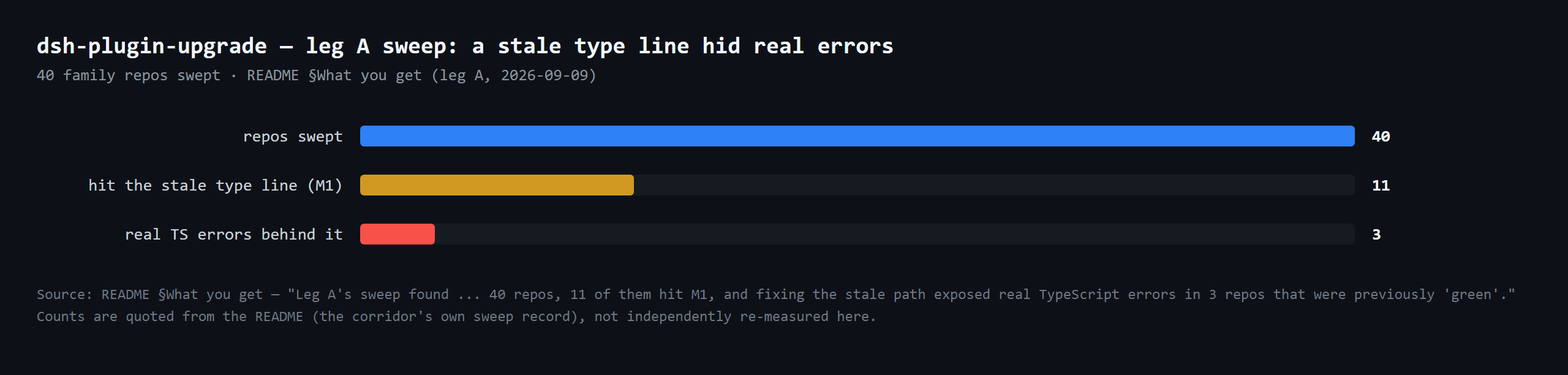
40 family repos swept · README §What you get (leg A, 2026-09-09)
Compatibility
| Surface | Status |
|---|---|
| Harness | DeepSeek Harness dsh-v0.2.1-alpha.1 (current line; dev/test pins 0.2.1-alpha.1). The corridor index is evidence-bound to the spans it measured: legAB = 0.1.3-alpha.1 → 0.1.5-rc.1 (tag dsh-v0.1.7-alpha.2 = 183f08e9c6dd; leg A→B handoff dsh-v0.1.7-alpha.2 = 5dda764ed3aa) and legC = 0.1.5-rc.2 → 0.1.6-alpha.2 (tag dsh-v0.1.7-alpha.2). Peer band @deepseek-ai/dsh-skill >=0.1.6-0 <0.2.0 || >=0.2.0-0 <0.3.0 || >=0.2.1-0 <0.3.0, @deepseek-ai/cordis ^4.0.5-alpha.1, @deepseek-ai/schemastery ^3.18.5-alpha.1. |
| Node | ^22.19.0 || >=24.0.0 |
| Platforms | Anywhere Node runs; the scanner is filesystem-only and platform-neutral |
| Model | Text-only models fully supported; the skill is a Markdown body, no tool or vision requirement |
| Corridor index | One package, one entry point. lib/route.mjs holds the closed corridors and the CLI routes to the matching one from the target repo's declared band (engines.dsh, the @deepseek-ai/dsh* ranges); --span legAB|legC overrides the guess and an undeclared band falls back to the older corridor. The two catalogs are never merged: each corridor keeps its own seam array, card, evidence, fixtures and parity gate. |
| Scope | Two closed corridors: legAB = 0.1.3-alpha.1 → 0.1.5-rc.1 (leg A + leg B), legC = 0.1.5-rc.2 → 0.1.6-alpha.2. A corridor never widens: a hop that adds a seam is a new corridor — a new card and a new index row, not a new package. |
| Legs | Every leg lives in this package: leg A keeps the S1–S10 + M1 seams, leg B keeps C1, C2, C4, C5, H1–H4, P1, and leg C keeps E1–E5 — each with its own evidence, card section, fixtures and rollback path. There is no sibling package to install. |
C3 | Retired: leg B's card spelled the stale-type-line false green C3, which is the same defect as leg A's M1. The fold is recorded on the card; --seams C3 matches nothing. |
| Sibling | Do not mount the retired dsh-plugin-upgrade in the same profile: both register the agent skill plugin-upgrade, so the second mount collides on the skill name. That package is deprecated on npm and its repository is retired; this package replaces both of its legs. |
What you get
Two halves, one seam catalog per corridor:
- A bundled agent skill (
plugin-upgrade) — the corridor cards and a fix-and-verify loop. The body first routes the caller to the corridor that matches its peer band; the model loads it only when a task actually needs it, and the package contributes no system-prompt paragraph and no tool. - A zero-dependency CLI (
dsh-plugin-upgrade-scan) — resolves the corridor and reportsfile:linefacts for that corridor's seams:legAB's twenty (S3,S8,S9,M1,S4,S5,S6,S7,S2,S1,S10,C1,C2,P1,C4,C5,H1,H2,H4,H3) re-read from the harness tag ranges on 2026-09-09 (leg A) and 2026-09-10 (leg B), orlegC's five (E1–E5) measured ondsh-v0.1.7-alpha.1(2026-09-19). Exit1on any error-severity hit, so it drops straight into CI.
The point is the failure mode this corridor exists to kill: this span's breakage is mostly silent, from both ends. The type line can be stale, so the repo compiles against the old catalog (seam M1), and the bare conversation client slot was deleted with no alias while ctx.slots.inject() only runs its callback when the declaration exists — so a client half that still targets it stops mounting with no error, no log line and no failed build (seam C1). Three classes of breakage survive typecheck + test:
- the local gate compiles a stale type line — old
pathsalias, or dev/test types pinned at0.1.5-alpha.*(seamM1); - a log writer omits the V3 required
streamfield, so the session imports and then refuses to resume (seamS3); - the tests are mocked against the old shape, so they pass while the host drops the contribution (seam
C1).
Honest sizing: leg B's workspace sweep found that the family's client halves use only 8 slot keys, all of which survive in rc.1 — for them the rc.1 breakage is latent, not actual. Third-party client plugins that targeted the bare conversation key are the ones that break, and they break quietly. Leg A's sweep found the opposite texture: 40 repos, 11 of them hit M1, and fixing the stale path exposed real TypeScript errors in 3 repos that were previously "green".
Quick start
dsh plugin --profile web add github:PerryLink/dsh-plugin-upgrade
# 1. install the bundle into your profile
dsh plugin --profile web add dsh-plugin-upgrade

# 2. verify the row mounted
dsh --profile web --dump-config | grep -A3 'id: dsh-plugin-upgrade'

# 3. scan the plugin you are upgrading
npx dsh-plugin-upgrade-scan --repo ../my-plugin
Then ask the agent to use the plugin-upgrade skill, or drive the loop yourself with the card that matches your band: skills/plugin-upgrade/references/v0.1.3-alpha.1-to-v0.1.5-rc.1.md (legAB — leg A is §1, leg B is §2, the merged seam index is §3) or skills/plugin-upgrade/references/v0.1.5-rc.2-to-v0.1.6-alpha.2.md (legC). The scanner picks the corridor for you; add --span legC when the declared band is ambiguous.
Examples
These are the plugin's real entry points; install once, then call one.
Detailed example
Command
dsh-plugin-upgrade-scan --repo fixtures/leg-a-bad-repo --seams S3
Output
# scan-0.1.5 · /mnt/d/Projects/dsh/plugins/dsh-plugin-upgrade/fixtures/leg-a-bad-repo
files scanned: 3 · hits: 1

## S3 [error] assistant/message 缺 stream(V3 必填) — 1 hit(s)
   action: 写入会话日志的 assistant/message 必须带 `stream: []`(或真实分片);缺了导入成功但会话不可续聊(Session.fromRestore 抛 invalid settlement fields)。
   fixtures/leg-a-bad-repo/src/index.ts:30  type: 'assistant/message',

H3 [info] card-only: the rc.1 additive capabilities are listed on the version card and are never auto-detected.
Observed from README.md:159-173 (Surfaces/CLI); test/scan.test.mjs:158; fixtures/leg-a-bad-repo/src/index.ts:30
Failure branch
Input
node scripts/scan-0.1.5.mjs --repo /nonexistent-upgrade-repo
Output
repo not found: /nonexistent-upgrade-repo
Observed from plugins/dsh-plugin-upgrade/lib/scan.mjs:510-514,523; plugins/dsh-plugin-upgrade/README.md:181-192
Brief examples
plugin-upgrade
Configuration
Every key is optional and lives in the profile patch:
| Key | Default | Meaning |
|---|---|---|
enabled | true | Register the packaged skill. Set false to keep the dependency mounted but silent. |
skillName | plugin-upgrade | Directory under skillsRoot to register, and the name shown in the catalog. |
skillsRoot | the package's own ./skills | Where <skillName>/SKILL.md lives. Point it at your own card to reuse the plumbing. |
userInvocable | true | Whether a human can invoke the skill by name in addition to the model. |
- insert:
    - id: dsh-plugin-upgrade
      name: dsh-plugin-upgrade
      config:
        skillName: plugin-upgrade
The plugin mounts loud: a missing SKILL.md, an empty body, or a frontmatter without name fails the mount instead of registering an empty skill.
Surfaces
Skill — plugin-upgrade (model- and user-invocable by default). Body: leg routing table, the 8 hard rules and the 6-step loop. References: the merged corridor card. Scripts: the detector, shipped inside the skill directory so relative paths resolve.
CLI — dsh-plugin-upgrade-scan:
dsh-plugin-upgrade-scan [--repo <path>] [--span legAB|legC|<span>] [--json <out.json>] [--seams S3,C1,P1] [--quiet]
| Flag | Meaning |
|---|---|
--repo <path> | Repository to scan (default: cwd). Its declared dsh band chooses the corridor. |
--span legAB|legC|<span> | Force a corridor instead of guessing from the declared band. An unknown band falls back to legAB. |
--json <out.json> | Also write the machine-readable report (repo, scannedAt, files, hits[], bySeam). |
--seams S3,C1,P1 | Restrict to specific seams of the resolved corridor's catalog (ids are never shared between corridors). |
--quiet | Suppress the human rendering (pair with --json). |
Exit codes: 0 no error-severity hit · 1 at least one error-severity hit · 2 usage or scan failure. A clean scan is necessary but not sufficient — the exit criterion is a real-host smoke, plus a resume round-trip for log writers (leg A) and a real browser assertion for the client half (leg B).
The twenty legAB seams
Order follows the catalog in lib/scan.mjs (leg A first, then leg B), which is also the order test/card.test.mjs pins the card to.
| Id | Severity | What changed on the way to 0.1.5-rc.1 |
|---|---|---|
S3 | error | assistant/message gained a required stream field (session format V3): a log written without it imports successfully and then refuses to resume (Session.fromRestore throws invalid settlement fields). |
S8 | error | SessionHandle.read() returns SessionHandleReadResult ({ eventState, events }) instead of the event array; array operations must unwrap .events. |
S9 | error | SystemPrompt's config renamed persona → personaPrefix / personaSuffix. Substituting includeHarnessIdentity: false is not equivalent — it deletes the harness identity block. |
M1 | error | The local gate compiles a stale type line: dev/test types pinned at 0.1.5-alpha.*, or a tsconfig paths alias resolving to a missing checkout directory, makes TypeScript fall back silently to the published types. Green gate, wrong ruler. |
S4 | error | tool/code-dispatch was renamed tool/ptc-dispatch; the old label is no longer recognized in V3 sessions. |
S5 | error | ctx.agent was removed: the caller must pass the Agent explicitly (e.g. the second parameter of setup(agentCtx, agent)). |
S6 | error | Inbox is a type interface, not a constructable class; fixtures use the official unsupported shape and runtime code reads agent.inbox. |
S7 | warn | SubprocessHandle.pid was removed (only SubprocessTerminalHandle.pid remains); drop the field from test fixtures. |
S2 | warn | EpochHeader.system was removed: the system prompt is surface node 0's system/message now. |
S1 | warn | Session format V3 and generation-suffixed log names — the current generation is session.v3.jsonl.zstd, so scripts that hardcode session.jsonl.zstd fail silently. |
S10 | warn | Plugin-authored session events must go through the host's fail-closed adaptation gate: Session.append has no ignorable write channel, so an unconditional append can make a session unreadable. |
C1 | error | The bare client slot conversation was deleted and replaced by main + main.conversation, with no alias. ctx.slots.inject() only fires when the declaration exists, so a plugin targeting it stops mounting silently. |
C2 | error | @deepseek-ai/dsh-client-ui-sidebar-textpreview was renamed …-sidebar-documentpreview; the old name is gone with no shim package. |
P1 | error | The peer band must keep its second segment: >=0.1.2-rc.1 <0.2.0 alone rejects 0.1.5-rc.1 under npm semver's prerelease-tuple rule (measured false on semver 7.8.5). |
C4 | warn | rc.1 added a global main-panel model (main, sidebar.panellist, ctx.layout.selectPanel(MainPanelId | null)) and appended a usePanelInfo standard prop to almost every slot. |
C5 | warn | Document preview moved to the keyed slot sidebar.right.tab.document (DocumentContent); sidebar.right.pane.tab survives but its parent entry became rightbar.session. |
H1 | warn | KNOWN_SESSION_EVENT_TYPES gained deliverables/presented and subagent/catalog — the fail-closed vocabulary grew. |
H2 | warn | The new present tool's row occupies tool.call.toolview key 'present', which was free in alpha.1. |
H4 | info | The DeepSeek adapter's default advisory catalog now leads with deepseek-flash (DeepSeek-V41-Flash). |
H3 | info | New optional capabilities: ctx.sessionFeedback, ctx.layout.beginNavigation(), ctx.workspaces.openSession() / openWorkspace() / forkSession(). Listed on the card; deliberately not auto-detected. |
S7, S2, S1, S10, C4, C5, H1, H2 and H4 are deliberately advisory: they have legitimate matches (a repo that already uses the new API, a documentation snapshot, a plugin's own model-id table, a Node ChildProcess.pid), so the scanner reports them as leads for manual review rather than failures. M1 and P1 are structured checks — they resolve package.json and tsconfig*.json instead of matching text — and H3 is card-only: documented, id-parity checked, and deliberately without a detector (CARD_ONLY = ['H3']).
The five legC seams (0.1.5-rc.2 → 0.1.6-alpha.2)
Order follows the catalog in lib/scan-0.1.6.mjs, which is also the order test/card.test.mjs pins the legC card to. Every seam here is error and every one is detected (CARD_ONLY = []).
| Id | Severity | What changed on the way to 0.1.6-alpha.2 |
|---|---|---|
E1 | error | agent/created listeners are dispatched serially: a listener that throws — or that does slow work — blocks agent creation outright. Wrap synchronous work in try/catch and defer the rest with queueMicrotask/setImmediate or your own queue. |
E2 | error | An async apply() whose first await precedes its registrations: anything registered afterwards lands in the unload window and throws INACTIVE_EFFECT, while the old closure keeps running. Register everything before the first await, inside one ctx.effect(). |
E3 | error | Deleted slot/state keys: settings.plugin.item became the keyed→list plugins.item, and SessionListState.current is gone — a settings card disappears silently (spec === undefined early return), and current casts keep compiling while the feature is dead. |
E4 | error | Deleted client API: sessions.open / openSubagent / clear became retain / using / retainInfo. |
E5 | error | Deleted model literals: deepseek-v4-flash* and deepseek-v4-vision-exp. The default model catalog shrank from 4 to 2, and an uncatalogued id passes through as text-only. |
The same discipline applies as for legAB: a clean scan is necessary, not sufficient. legC breakage is silent or runtime-only (the published type line hides the deletions), so the exit criterion stays a real-host smoke on a temp DSH_HOME, plus the log-writer round-trip and the real-browser assertion where they apply.
What this does not cover
- A hop past every corridor here.
legABends at0.1.5-rc.1by construction: the harness hop0.1.5-rc.1→0.1.5-rc.2added no plugin-facing seam (this package's own dev/test pin now runs on the0.1.7-rc.2line, so the catalog is verified against those published types; the compat workflow's probe still anchors0.1.6-alpha.2), andlegCcovers0.1.5-rc.2→0.1.6-alpha.2. A later hop that adds a seam is not covered: a corridor is closed, and widening a card is worse than adding one. It gets a new card and a new index row — not a new package. - The
0.1.1→0.1.2hop. Use the community convergence skill. - Restating across legs. Leg A owns the session-format seams (
assistant/message.stream,SessionHandleReadResult,EpochHeader.system,ctx.agent,Inbox,SystemPrompt.persona, the V3 log generation) and leg B does not restate them — the wholepackages/core/session/srcdiff in leg B's range is two added event-type literals and one comment line. Each leg's card section keeps its own scope statement. - The DSH user-facing upgrade path. This package upgrades plugin source code, not a user's harness installation.
- Theme tokens.
docs/web-styling.mdhas zero changes in leg B's range. - Proof. A clean scan is a hypothesis. The exit criterion is a real-host smoke (temp
DSH_HOME, target CLI,plugin add <tarball>,--dump-config) plus a resume round-trip for session-log writers (leg A) and a real browser assertion for every client-side hit (leg B).
Security boundaries
- Read-only scan. The CLI never writes inside the scanned repository;
--jsonwrites only to the path you pass. - No network, no shell. The scanner imports nothing beyond Node's standard library and never spawns a process.
- No secrets. Nothing in the package reads credentials, environment tokens, or session data.
- Sandboxed smoke recipe. The card's real-host check uses a
mkdtempDSH_HOME; it never touches your real~/.dsh.
Development
npm install                        # or: pnpm install (the repo ships a pnpm-lock.yaml)
npm test                           # node --test: scanner, card<->catalog parity, real Cordis + SkillRegistry
npm run verify:self-contained      # every import resolves inside the package
npm run verify:artifacts           # the packed tarball carries the skill, CLI and patch, and excludes tests
npm run check:readmes              # five-language README consistency
npm pack
The scanner has a synthetic fixture pair per legAB leg: fixtures/leg-a-bad-repo (leg A's session/config seams, every error seam present on purpose) with fixtures/leg-a-good-repo (adapted), and fixtures/bad-repo (leg B's client-slot seams) with fixtures/good-repo (adapted) — plus a live negative on a family repository already pinned to 0.1.5-rc.1, so a regression in the catalog fails the suite rather than a downstream user. test/card.test.mjs asserts that each card's index and its own catalog (lib/scan.mjs for legAB, lib/scan-0.1.6.mjs for legC) name exactly the same seam ids with the same severities, that legAB's CARD_ONLY is exactly ['H3'] while legC's is empty, and that the two catalogs share no seam id — the evidence-binding rule as a machine gate, per corridor.
Topics
dsh, dsh-plugin, deepseek-harness, deepseek, cordis, plugin-upgrade, migration, skill, version-card, scanner, client-slots (mirror package.json keywords; dsh-plugin is the ecosystem's visibility channel).
PerryLink DSH Plugin Family
This project is part of the DeepSeek Harness plugin family from PerryLink. The roster stays collapsed below so every README keeps a short first screen; expand it to see every row and its status.
Expand all plugins
License
Apache-2.0 — see LICENSE. Install-time dependencies and their licenses are listed in THIRD_PARTY_NOTICES.md; nothing is bundled.