
 @598934321
dsh-quota-pill
Quota pill for DeepSeek Harness: how much is left on every LLM subscription, in one pill
- Stars
- 0
- Language
- JavaScript
- Created
- Oct 21, 2026
- Updated
- Oct 21, 2026
Introduction
dsh-quota-pill
A quota pill for the DeepSeek Harness web GUI: how much is left on every LLM subscription you have, in one collapsible pill next to the composer.
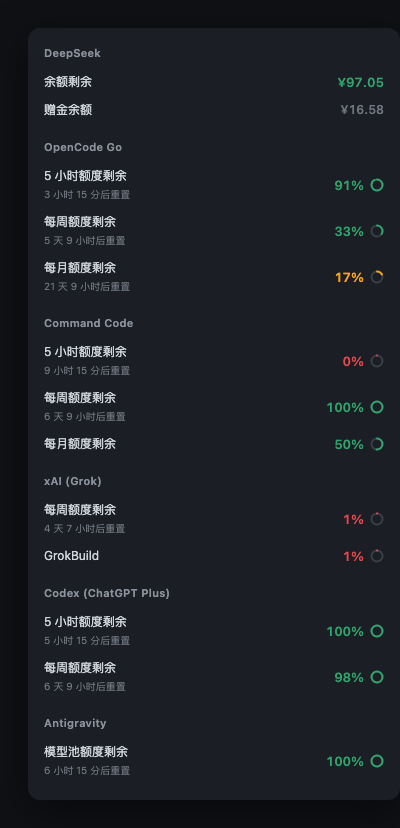
It sits in the composer toolbar, shows the tightest window at a glance, and opens into a per-provider breakdown with reset times. Switch sessions and it follows the model — showing that provider's last reading while it refreshes, then easing into the live number.
What it reads
| Provider | Credential |
|---|---|
| DeepSeek (official) | the Platform sign-in DSH already holds — nothing to add |
| Kimi Coding | refs.KIMI_CODING_API_KEY in ~/.dsh/.credentials.yaml |
| OpenCode Go | refs.OPENCODE_GO_API_KEY |
| Command Code | refs.COMMANDCODE_API_KEY |
| xAI (Grok) | OAuth token from CLIProxyAPI |
| Codex (ChatGPT Plus) | same — and CLIProxyAPI must be running |
| Antigravity | same |
DeepSeek works with no setup at all if you are signed in to DeepSeek Platform in DSH — that is the official account, and it is the one most users care about.
The three API-key providers need nothing but the key. The three OAuth providers need CLIProxyAPI installed and logged in, because that is what holds the tokens; this plugin only reads them and never runs an OAuth flow itself.
Every provider is optional. Unconfigured ones say exactly what is missing instead of showing a fake zero.
Install
# 1. the DSH plugin
dsh plugin add @hystudio/dsh-quota-pill

# 2. the sidecar (reads credentials, talks to upstream APIs)
npx @hystudio/dsh-quota-pill
The npm package is
@hystudio/...while the repo lives at598934321/...— they are the same author under two account names.
The pill shows "quota service is not running" with that exact command until the sidecar is up. Keep it running in the background — see Running it as a service.
Then add whichever keys you have:
# ~/.dsh/.credentials.yaml
refs:
  KIMI_CODING_API_KEY: sk-...
  OPENCODE_GO_API_KEY: sk-...
  COMMANDCODE_API_KEY: sk-...
Reload the DSH window. Done.
Let an agent do it
The repo ships AGENTS.md — a step-by-step guide written for an AI
agent. Ask your agent to set the plugin up and it will detect what you already
have, ask only for what it cannot know (your keys), write them safely, and verify
each provider end to end.
Read AGENTS.md in this repo and set up dsh-quota-pill for me.
Running it as a service
npx in a terminal dies with the terminal. Pick one:
macOS (launchd) — ~/Library/LaunchAgents/dev.quota-pill.plist
<?xml version="1.0" encoding="UTF-8"?>
<!DOCTYPE plist PUBLIC "-//Apple//DTD PLIST 1.0//EN"
  "http://www.apple.com/DTDs/PropertyList-1.0.dtd">
<plist version="1.0"><dict>
  <key>Label</key><string>dev.quota-pill</string>
  <key>ProgramArguments</key>
  <array>
    <string>/usr/bin/env</string><string>node</string>
    <string>/absolute/path/to/bin/quota-pill-server.js</string>
  </array>
  <key>RunAtLoad</key><true/>
  <key>KeepAlive</key><true/>
</dict></plist>
launchctl load ~/Library/LaunchAgents/dev.quota-pill.plist
Linux (systemd) — ~/.config/systemd/user/quota-pill.service
[Unit]
Description=dsh-quota-pill sidecar

[Service]
ExecStart=/usr/bin/env node /absolute/path/to/bin/quota-pill-server.js
Restart=always

[Install]
WantedBy=default.target
systemctl --user enable --now quota-pill
How it works
DSH web GUI
   └─ client.js          renders the pill; never sees a credential
        │  HTTP (localhost)
        ▼
      sidecar           reads ~/.dsh/.credentials.yaml and ~/.cli-proxy-api/*.json,
                        calls each provider's quota endpoint, caches 60s
Two processes because credentials must never reach the browser, and because
upstream calls need real timeouts and a TLS stack Node's fetch does not have
for some hosts.
Endpoints
| Path | Purpose |
|---|---|
GET /health | liveness + provider list |
GET /quota?model=<id> | one provider's reading, selected by model prefix |
GET /quota/all | every provider, concurrently |
GET /setup | what each provider still needs |
?fresh=1 bypasses the 60-second cache.
Response
{
  "kind": "subscription-quota",   // subscription-quota | payg | none | probe-failed
  "provider": "opencode",
  "displayName": "OpenCode Go",
  "remainingPct": 17,             // remaining, never used
  "window": "monthly",            // the binding window
  "resetAt": "2026-11-12T00:00:00.000Z",
  "products": { "rolling": 9, "weekly": 67, "monthly": 83 },  // per-window used%
  "windows": [                    // one row each in the UI
    { "key": "monthly", "remainPct": 17, "resetAt": "..." }
  ],
  "cached": false,
  "at": 1792500000000
}
kind is meant to be exhaustive so the UI never has to guess:
subscription-quota— a real percentage existspayg— metered billing, no ceiling (shows spend, not a percentage)none— not configured;errornames the missing credentialprobe-failed— configured but the upstream call failed
Notes on specific providers
Codex is read through CLIProxyAPI's management API, which reports the
X-Codex-* headers CLIProxyAPI observed while proxying real traffic. The direct
chatgpt.com/backend-api/codex/usage endpoint sits behind Cloudflare and rejects
non-browser TLS fingerprints, so it only works as a fallback. CLIProxyAPI must be
running, not merely installed.
xAI has three account generations: grandfathered plans report a percentage
directly, current plans only reveal allowance in x-ratelimit-* response headers
of a one-token completion, and unified-billing accounts have no ceiling at all
(reported as payg).
Antigravity shares one quota pool across all Gemini models, so it reports a single aggregate row — per-model rows would all be the same number and the label would flicker between models you do not even have configured.
Command Code does not expose a monthly ceiling. The adapter derives it from
monthlyCap = weekly.cap × 2, an identity verified against two different plans
(31.6 + 38.4 = 70 with weekly.cap 35; 0.225 + 9.775 = 10 with weekly.cap 6).
DeepSeek is a prepaid CNY wallet, so there is no percentage to show — the pill
shows the balance and, separately, any bonus credit. Two traps worth recording:
the stored credential is a Platform login grant, not an api.deepseek.com API
key (sending it there returns 401), and calling platform.deepseek.com directly
returns 429 from Cloudflare. The balance is therefore read through DSH's own
account/getBalance RPC, which already holds the grant and projects the response
down to wallet currency and balance. We never handle the Platform token ourselves.
Privacy
- Credentials are read from disk, used for the upstream call, and never logged.
- The sidecar binds
127.0.0.1only. - Nothing is sent anywhere except the provider's own quota endpoint.
- The client shows no credential, and the sidecar's JSON carries no token.
Development
git clone https://github.com/598934321/dsh-quota-pill
cd dsh-quota-pill
npm test              # 26 tests, offline
npm start             # sidecar on :8319
Tests are offline by design: they point the credential layer at a nonexistent
directory so they never touch a live account. Fixtures in test/fixtures.js are
synthetic — no real emails, account ids, or balances.
License
MIT